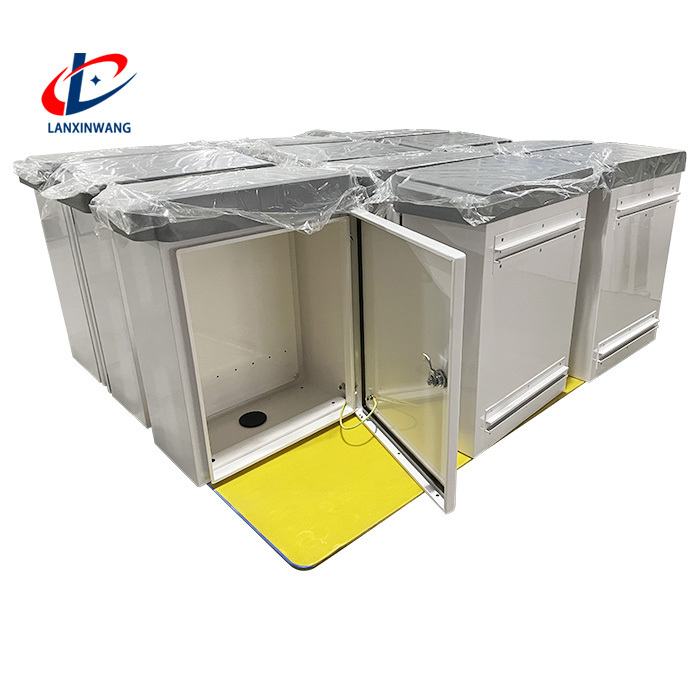
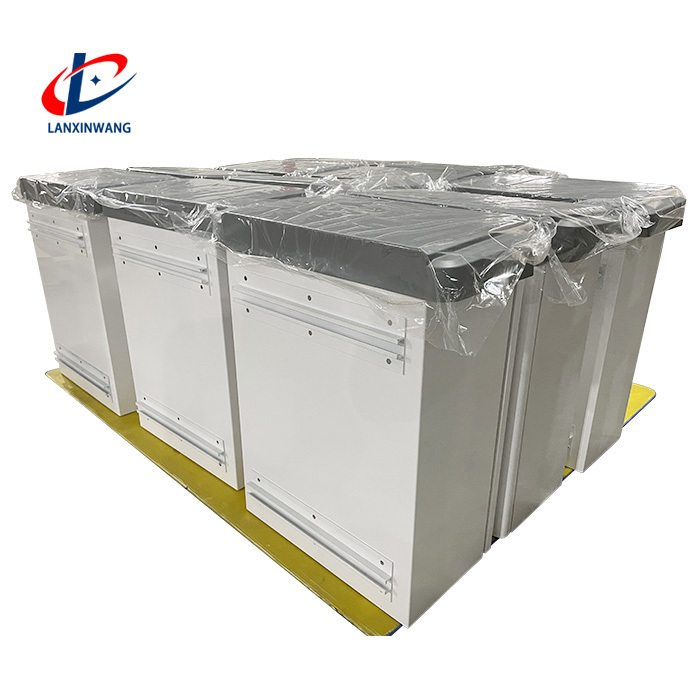
Custom Powder Coated Carbon Steel Industrial Waterproof Electrical Control Box
This industrial electrical control cabinet is constructed from sheet metal and features a lockable door design, facilitating equipment maintenance and safety management. The cabinet includes pre-drilled mounting holes and cable entry openings to accommodate the installation of various electrical equipment and control systems, making it suitable for both indoor and outdoor industrial environments.
| Material Types | Carbon Steel / Stainless Steel / Aluminium / Iron, etc. |
| Fabrication Method | Laser Cutting / Metal Bending / Tube Bending / Stamping / Machining / Welding / Riveting, etc. |
| Surface Treatment | Wire Drawing / Surface Grinding / Polishing / Electroplating / Anodising / Powder Coating / Baking Finish / High-temperature Coating / Sand Blasting / Enamelling / Pickling & Passivation, etc. |
| Cutting Precision | ±0.1 mm (±0.004 in) |
| Bending Range | 0.3-10 mm (0.012 - 0.394 in) |
| Pressure Tonnage Range | 35T - 150T |
| Pipe Bending Diameter Range | 6-200 mm (0.236 - 7.87 in) |
| Acceptable Drawing Formats | PDF / DWG / DXF / STEP (.step/.stp) / IGES (.iges/.igs) / SolidWorks files (.sldprt/.sldasm) |
| Production Support | Prototype to Mass Production |
Uses
Widely used in industrial automation, power distribution, telecommunications equipment, mechanical control systems, and outdoor equipment protection.
One-Stop Sheet Metal Solutions, From Concept to Production

FAQ
Q1: Can the enclosure dimensions and layout be customized based on the internal electrical components?
A1: Yes. We can customize the enclosure structure, mounting plate layout, and internal space configuration according to your requirements.
Q2: Can the locations of cable entry ports, ventilation openings, and other cutouts be customized?
A2: Yes. We can customize these according to drawings or project requirements.
A3: Can this cabinet be used outdoors or in special environments?
A3: Yes. We can provide corresponding waterproof, dustproof, and corrosion-resistant design solutions based on the operating environment to meet the application needs of different projects.
Q4: What factors should be considered when selecting sheet metal materials?
A4: Strength, corrosion resistance, formability, the operating environment, and cost should all be taken into account to achieve optimal product performance and cost-effectiveness.
Q5: How does the bending radius affect the quality of sheet metal fabrication?
A5: A proper bending radius helps prevent material cracking, improves dimensional accuracy, and ensures consistent forming quality.
Q6: How can deformation during sheet metal welding be minimized?
A6: By optimizing weld design, controlling the welding sequence, and using specialized fixtures, welding deformation can be effectively reduced and assembly accuracy improved.