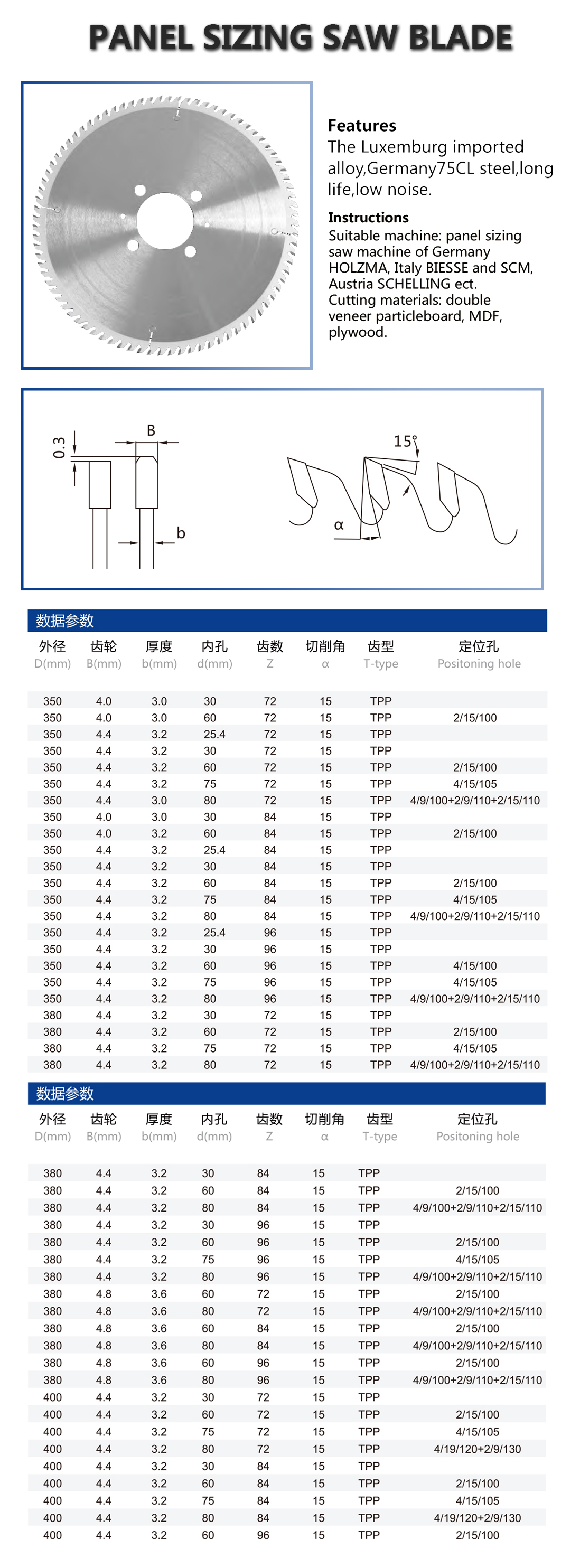
The electronic cutting saw blade produced by our company offers material savings, smooth surface cutting, no burrs, and no edge breakage.
| Applicable Machines | Germany Homag, Italy Bia, Italy SCM, Austria Schelling, Taiwan Taiwan Exhibition, Taiwan Yuanming, Nan Xing, Extreme East, Zheng Tai, Taiwan Ring Hong |
|---|---|
| Features | Luxembourg imported alloy, Germany 75Cr1 steel plate, long service life, ultra-low noise |
| Cutting Materials | Cork, hardwood, medium-thickness board, particleboard, single-side bonded particleboard, double-side bonded particleboard, single-side bonded MDF board, plywood, fiberboard, and more |
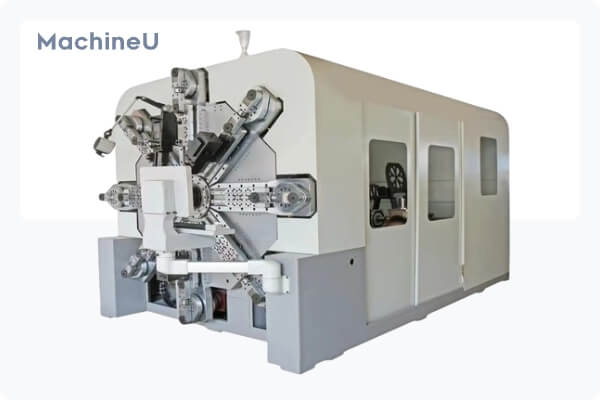
An electronic saw, also known as an electronic cutting saw, uses automatic PC computer or numerical control program control with man-machine integrated operation. Operators input data on a touch screen, and the machine runs automatically to perform precision cutting of panels.
In recent years, with the rapid development of the panel processing industry and increasingly strict requirements for panel cutting, traditional ordinary saws have struggled to meet production needs. Ordinary sizing saws have low cutting efficiency, insufficient precision, and low safety. Push-table saws and other ordinary sizing saws are powerless in the face of high-efficiency production lines, hindering further enterprise development. The emergence of the electronic saw effectively solves these problems. Electronic saws use robotic arm clamping for automatic feeding and automatic positioning for precision cutting.
Electronic saws can be widely used for precision cutting of particleboard, density board, MDF board, gypsum board, circuit board, aluminum board, copper clad board, acrylic board, plastic board, aluminum plastic board, ABS board, PVC board, and other panels.
Common tooth shapes for alloy saw blades include left and right teeth (alternate teeth), flat teeth, ladder flat teeth (high and low teeth), inverted trapezoid teeth (inverted conical teeth), dovetail teeth (hump teeth), and rare industrial-grade three-left-one-right and left-right flat teeth.
To summarize: for sawing solid wood, particleboard, and dense board, choose left and right teeth to sharply cut wood fiber tissue for a smooth incision. To keep the groove bottom flat, use a flat tooth profile or a left-right flat combination tooth. For sawing stick panels and fire boards, generally choose ladder flat teeth. Computer cutting saws, due to their sawing rate, use alloy saw blades with relatively large diameters and thicknesses — approximately 350–450 mm in diameter and 4.0–4.8 mm in thickness — mostly with ladder flat teeth to reduce edge collapse and saw marks.