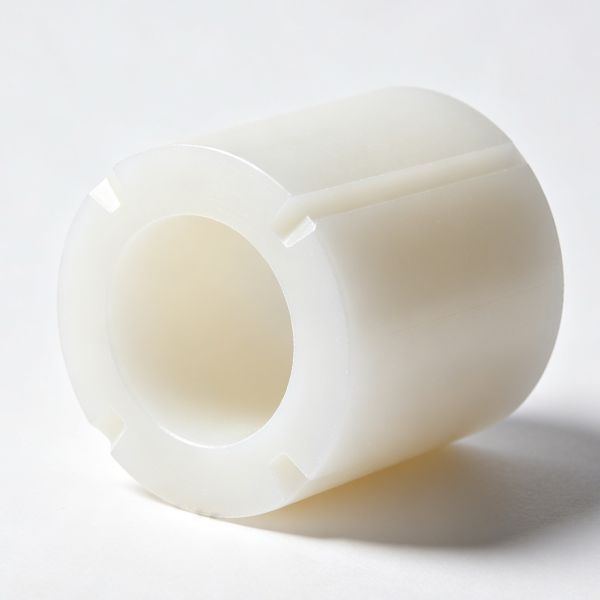
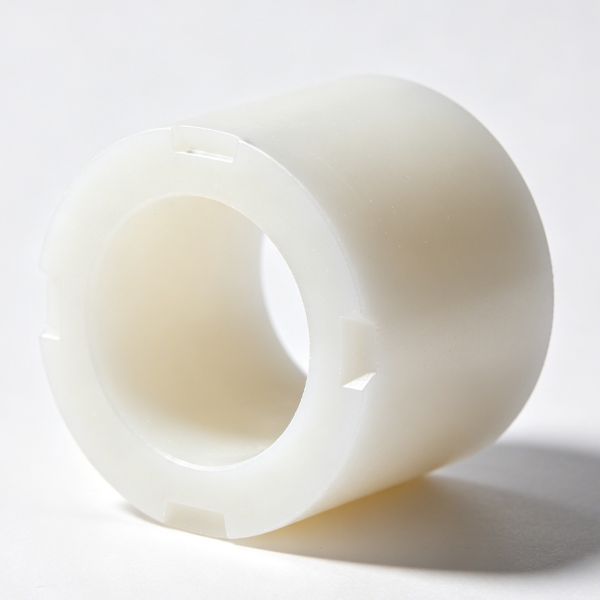
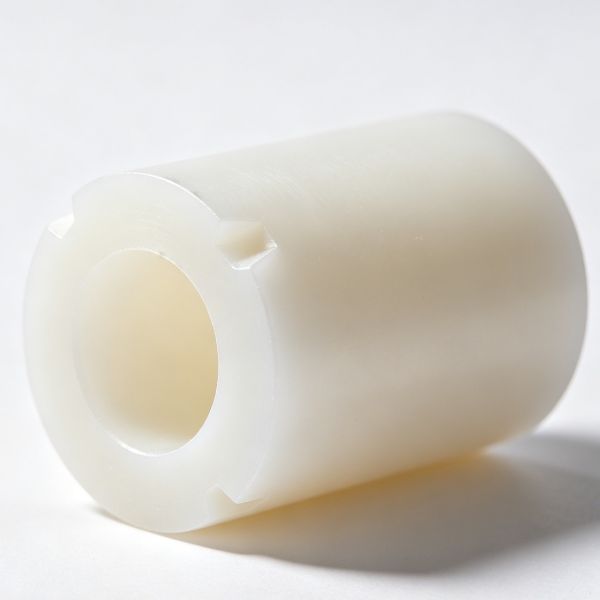
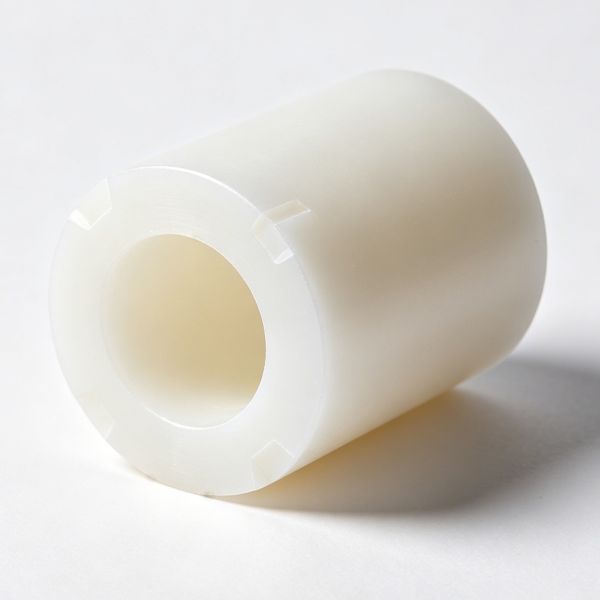
CNC Turned Delrin Bearing Sleeve for Industrial and Automotive Applications
Delrin (POM - Polyoxymethylene) is an often-overlooked engineering plastic that frequently outperforms both Nylon and PEEK in many applications. It offers superior machinability, tighter tolerance capabilities, minimal moisture absorption (0.25% vs 8-10% for Nylon), and costs approximately one-fifth of PEEK.
For bearing sleeves specifically, Delrin represents the optimal material choice. It features a low coefficient of friction (0.1-0.3 against steel), excellent wear resistance, outstanding dimensional stability, and sufficient stiffness to maintain bearing clearance under load. While Nylon offers greater toughness and PEEK provides higher strength, Delrin occupies the sweet spot for most bearing sleeve applications.
Frequently Asked Questions
Delrin or Nylon for my bearing sleeve?
Delrin offers superior dimensional stability and machinability, while Nylon provides better impact resistance and load capacity. For humid or wet environments, Delrin is typically the better choice as Nylon absorbs water and may swell, potentially causing bearing seizure. For impact-loaded applications, Nylon's higher toughness may be advantageous.
Can Delrin replace a bronze bearing sleeve?
Yes, for low-to-medium speed applications (under 1,000 RPM surface speed). Delrin sleeves are self-lubricating, lighter (1/6 the weight of bronze), corrosion-proof, and more cost-effective to machine. The trade-offs include lower load capacity and temperature rating compared to bronze or steel bearings.
What's the difference between Delrin and POM copolymer?
Delrin is POM homopolymer with higher tensile strength, stiffness, and fatigue resistance. POM copolymers offer better chemical resistance to strong bases and improved thermal stability. For most bearing applications, the differences are negligible and either grade performs well.
Do you offer PTFE-filled Delrin (Delrin AF)?
Yes. Delrin AF features an even lower coefficient of friction and is recommended for high-speed or high-PV bearing applications. It machines similarly to standard Delrin but costs approximately 30% more.
Can you machine very thin-walled sleeves?
We can machine sleeves down to approximately 1mm wall thickness on bore diameters up to 50mm. Below this thickness, sleeve deflection during machining makes tolerance maintenance challenging. Alternative approaches include using thicker rod stock or specialized tube stock for very thin walls.
What's the lead time for 1,000 bearing sleeves?
7-10 days. Delrin's excellent machinability and material availability enable production rates of 3,000-5,000 pieces per day on a single CNC lathe for simple geometries. Additional processes like plating or post-machining treatments may add 2-3 days.