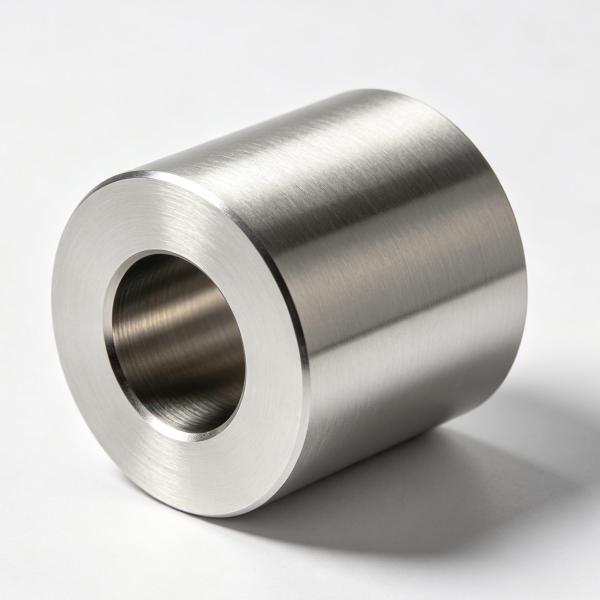
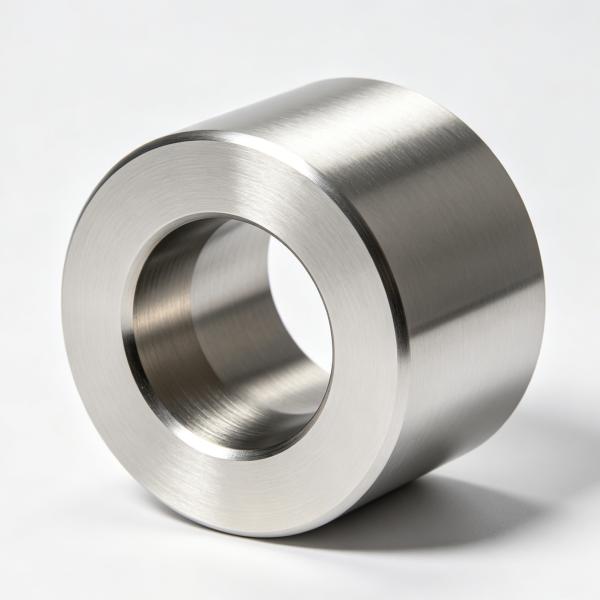
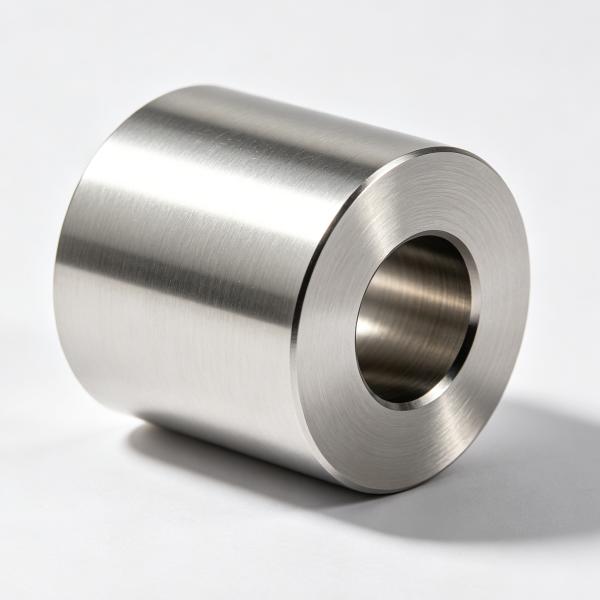
A pump sleeve sits on the shaft between the impeller and the bearing housing, protecting the shaft from wear at the seal and packing locations. When the mechanical seal or packing runs against the shaft, it gradually wears a groove into the metal. A replaceable sleeve takes that wear instead of the shaft - when the sleeve wears out, you replace a $20 sleeve instead of a $500 shaft.
Sounds simple. The engineering challenge is in the fits. The sleeve needs to slide onto the shaft with a close clearance fit (H7/g6 or similar), run true to within 0.01mm (so the seal sees a consistent surface), and not creep or rotate on the shaft under operating conditions. Most pump sleeves are secured with a setscrew, a key, or an interference fit at one end.
We turn pump sleeves from SS 316 or SS 304 round bar stock. The ID (shaft bore) is the most critical dimension - it needs to be round, straight, and on-size for a consistent fit on the shaft. We bore the ID in the same chucking as the OD to maintain concentricity. The OD (seal surface) needs to be smooth (Ra 0.4 for mechanical seals, Ra 0.8 for packing) and hard enough to resist wear. For extended life in abrasive pump applications, we can hard chrome plate the OD and grind it to final dimension.
The decision between SS 304 and SS 316 is straightforward for pump sleeves. If the pump handles water, mild chemicals, or food products, 304 is fine. If it handles seawater, chlorides, or corrosive chemicals, use 316. The cost difference is about 25-30% per piece, but a corroded sleeve in a chemical pump is a pump failure, so the premium is almost always justified for corrosive service.
Frequently Asked Questions
Q: SS 304 or SS 316 for my pump sleeve?
A: If the pump handles water, oil, or mild chemicals, 304 is fine. If it handles anything corrosive - chlorides, seawater, acids, brine, process chemicals - go 316. For especially aggressive environments, consider 17-4 PH (high strength, good corrosion resistance) or Duplex 2205 (superior corrosion and stress corrosion cracking resistance).
Q: Do I need hard chrome on the seal surface?
A: For clean water pumps with mechanical seals, usually no - bare SS 316 works fine. For slurry pumps, pumps handling abrasive particles, or pumps with packing (which is more abrasive than mechanical seals), hard chrome extends sleeve life 3-5x. The cost premium is about 30-40% per sleeve but you replace it less often.
Q: What tolerance do I need on the shaft bore?
A: H7 (ISO tolerance class) is standard for pump sleeves. This gives a close clearance fit on an h6 shaft. For example, a 50mm H7 bore is +0.000/+0.025mm, fitting with a 50mm h6 shaft of -0.000/-0.016mm. Result: 0.016-0.041mm clearance. Tight enough to prevent sleeve wobble, loose enough to slide on by hand.
Q: Can you reverse-engineer a worn sleeve?
A: Yes. Send us the worn sleeve and we'll measure it, identify the material (PMI testing), and make a replacement. Worn sleeves are typically oversized on the ID (from shaft wear) and undersized on the OD (from seal wear), so we interpolate the original dimensions. If you can provide the shaft diameter, we'll size the bore correctly.
Q: What's the maximum sleeve length you can machine?
A: Up to 600mm on our standard CNC lathes with tailstock support. For sleeves longer than 600mm (some vertical turbine pump sleeves), we can bore on a horizontal boring machine. Longer sleeves need support at both ends during turning to prevent deflection.
Q: How fast can you make an emergency replacement?
A: 3-5 days for standard SS 316 sleeves in common bore sizes (25-100mm), assuming material is in stock. Hard chrome adds 3-5 days. We've done same-day turnaround for local customers in Dongguan with a pump down situation.