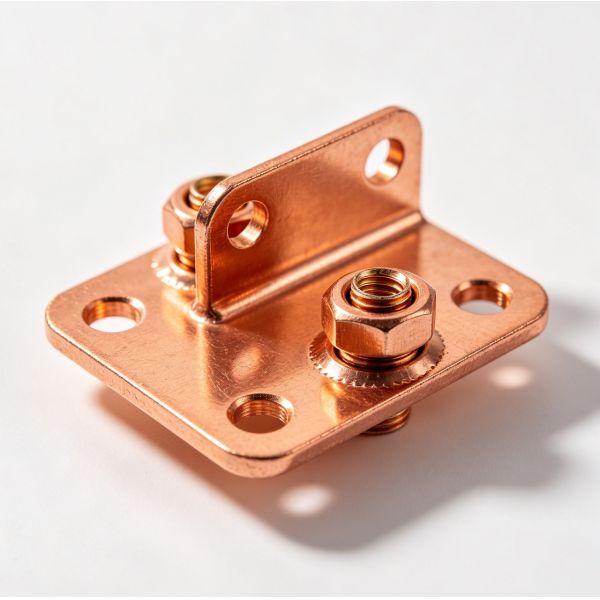
A grounding terminal is the kind of component that nobody thinks about until something goes wrong. It sits in a switchgear panel, in a transformer enclosure, or at the base of a lightning protection mast. It carries the current that's supposed to protect everything else — and if it fails, the consequences aren't measured in warranty returns. They're measured in equipment fires, arc flash incidents, and safety violations that shut down a factory.
Copper C11000 (ETP copper) is the standard material for grounding terminals, and for good reason. Its electrical conductivity (101% IACS minimum) means it carries fault current with minimal voltage drop. Its thermal conductivity means it dissipates heat generated during fault events before the terminal itself becomes the failure point. And it's available in the sheet thicknesses that stamping operations require — typically 2mm to 6mm for grounding terminals rated 200A to 2000A.
The stamping challenge on grounding terminals is the hole pattern. A typical grounding terminal has 6 to 12 bolt holes, some of which are clearance holes for M8 or M10 grounding bolts and others are tap holes for mounting studs. The clearance holes need to be positioned within ±0.1mm because the bolt spacing on the grounding bus they connect to is fixed. The tap holes need clean threads — copper taps poorly if the thread depth exceeds 1.5x the diameter without proper tooling and peck cycle.
We've been stamping and machining copper electrical components for years. The process for grounding terminals combines stamping (for the flat terminal body) with secondary CNC operations (for tapped holes, countersinks, and edge finishing). This hybrid approach gives us the speed of stamping for high-volume blanks with the precision of CNC for the critical connection features.
Frequently Asked Questions
Q: Why use C11000 instead of C10200 for grounding terminals?
A: C11000 (ETP copper) is the most cost-effective option for grounding terminals and has excellent conductivity (101% IACS minimum). C10200 (OFHC copper) is oxygen-free, which matters for vacuum tube and semiconductor applications but adds cost with no benefit for grounding. For standard grounding applications, C11000 is the correct choice.
Q: Do you recommend tin plating for outdoor grounding terminals?
A: Yes, absolutely. Bare copper oxidizes in outdoor environments, forming a copper oxide layer that increases contact resistance over time. Tin plating (3-8um) prevents oxidation and maintains low-contact-resistance connections for the terminal's service life. For indoor applications in dry environments, bare copper is acceptable.
Q: What's the maximum current rating you can produce?
A: For stamped terminals, 2000A is practical with 6-8mm copper thickness. Above that, you're looking at machined solid bar terminals or brazed assemblies — we can produce those too, but the process and pricing are different.
Q: Can you add mounting studs instead of tapped holes?
A: Yes. We can press-fit or brazed-mount copper studs onto the terminal body. Press-fit studs are faster and cheaper for volume; brazed studs are stronger for high-vibration applications. We'll recommend the best approach based on your installation environment.
Q: Do you provide UL or CSA certification on grounding terminals?
A: The terminal itself is a mechanical/electrical component. UL listing applies to the complete assembly (switchgear, panel, etc.) that uses the terminal. We can manufacture terminals that meet the material, dimensional, and plating requirements of UL 467 (Grounding and Bonding Equipment) specifications.