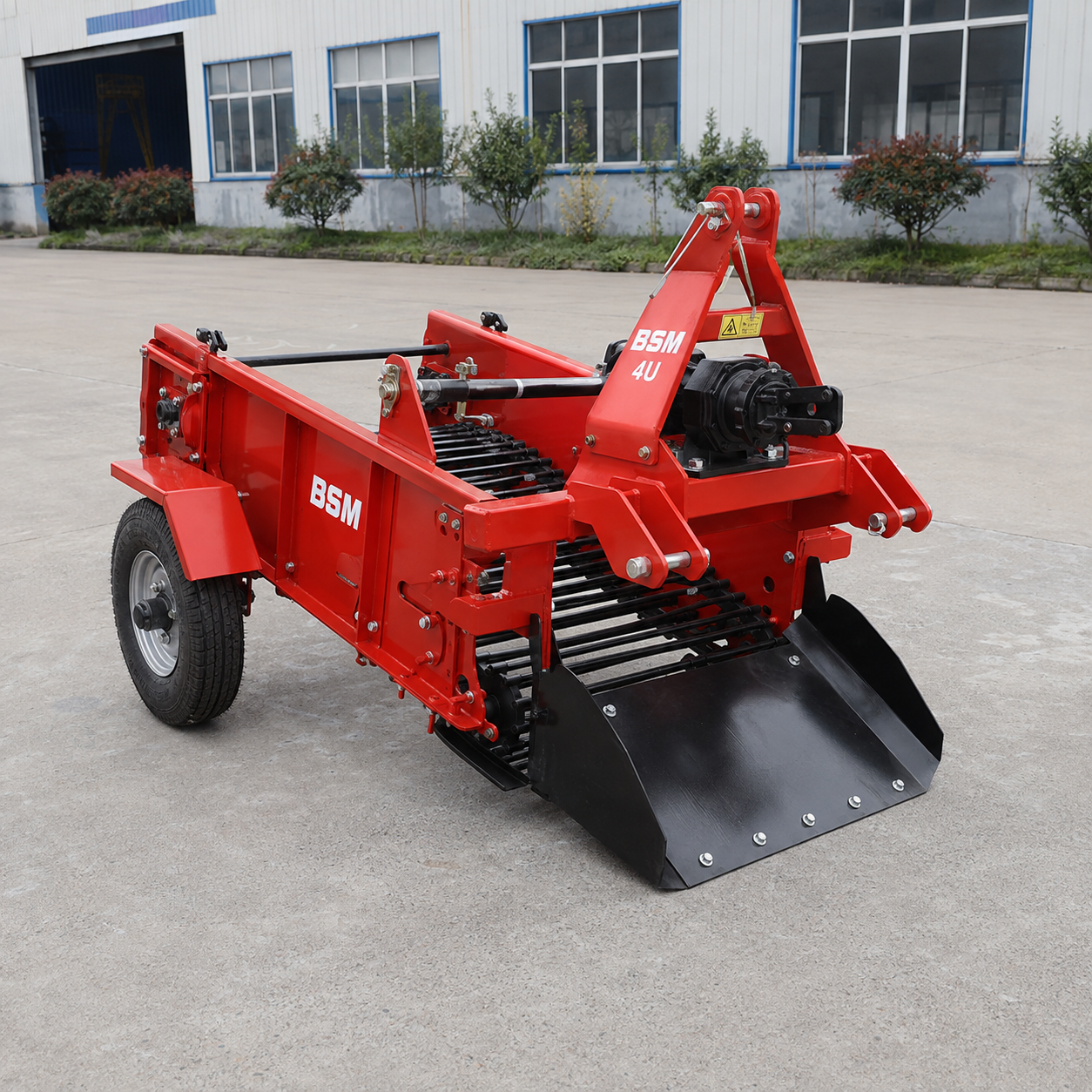
The BSM 4U Series Potato Harvester is designed for agricultural tractors from approximately 20HP to 80HP. It is used to lift mature potatoes from prepared ridges, separate loose soil and moderate crop residue, and place the harvested tubers on the field surface for convenient collection.
The machine combines a digging blade, conveying structure and vibrating soil-separation system. During operation, the digging blade enters below the potato layer and lifts the ridge together with potatoes and surrounding soil.
The lifted material then moves onto the conveyor. Loose soil falls through the conveyor gaps, while potatoes continue toward the rear discharge area and are placed on the field surface.
Different working widths, harvesting-row configurations and conveyor structures can be selected according to tractor power, ridge spacing, soil conditions, potato variety and required daily harvesting capacity.
Main Agricultural Applications
- Mechanized potato harvesting
- Lifting mature potatoes from prepared ridges
- Separating loose soil from harvested tubers
- Reducing manual digging labour
- Exposing potatoes on the field surface for collection
- Improving harvesting efficiency during the harvest season
- Working with single-row potato ridges
- Working with double-row or wider configurations when suitable
- Supporting medium and larger potato production systems
How the 4U Potato Harvester Works
The potato harvester connects to the tractor through the rear three-point hitch.
Depending on the selected configuration, the conveyor and vibrating separation system may be driven through the tractor PTO or a suitable mechanical transmission.
The front digging blade enters the soil below the potato layer and lifts the complete ridge section. Potatoes, soil and crop residue then move onto the conveyor.
The conveyor vibrates during operation. Loose soil falls through the chain or conveyor-bar gaps, while potatoes and larger materials continue toward the rear discharge area.
The harvested potatoes are then placed on the soil surface behind the machine. Workers or suitable collection equipment can gather the exposed tubers more efficiently.
Main Product Features
- Potato Lifting and Soil Separation: The machine lifts the potato ridge and separates loose soil from the harvested tubers.
- Vibrating Conveyor Structure: Vibration helps soil fall through the conveyor while potatoes continue toward the rear.
- Adjustable Harvesting Depth: Working depth can be adjusted according to ridge height, potato depth and soil conditions.
- Heavy-Duty Digging Blade: The front blade works below the potato layer to reduce missed potatoes.
- Low-Impact Rear Discharge: Harvested potatoes are placed on the field surface for easier collection.
- Three-Point Mounted Structure: The harvester connects directly to compatible agricultural tractors.
- Different Working Widths: Different configurations can be supplied according to ridge spacing and tractor size.
- Single-Row and Multi-Row Options: Harvesting-row quantity depends on the selected configuration.
- Replaceable Wearing Parts: Digging blades, conveyor bars, chains, sprockets and related wearing parts can be replaced.
- OEM Support: BSM can customize color, logo, working width, harvesting rows and selected conveyor structures.
Available 4U Configurations
| Configuration | Harvesting Rows | Tractor Matching | Typical Application |
| Compact Configuration | Single Row | Confirmed According to Configuration | Small farms, narrow ridges and compact tractors |
| Standard Configuration | Single or Double Row | Confirmed According to Configuration | Small and medium potato farms |
| Wide Configuration | Multi-Row | Confirmed According to Configuration | Larger potato fields and higher daily harvesting capacity |
The 20-80HP tractor range is a general reference for the current 4U Series. Final tractor matching depends on working width, harvesting rows, machine weight, conveyor structure, soil resistance, field slope and rear lifting capacity.
Technical Parameters to Be Confirmed
| Parameter | Configuration |
| Model | Confirmed According to Working Width and Harvesting Rows |
| Working Width | Confirmed According to Ridge Spacing and Selected Model |
| Harvesting Rows | Single-Row or Multi-Row Configuration |
| Working Depth | Adjustable According to Potato Depth and Soil Conditions |
| Matched Tractor Power | Approx. 20-80HP, Subject to Final Confirmation |
| PTO Speed | Confirmed According to Selected Transmission |
| Machine Weight | Confirmed According to Working Width and Conveyor Structure |
| Working Efficiency | Depends on Working Width, Tractor Speed and Field Conditions |
| Potato Damage Rate | Depends on Adjustment, Soil Conditions and Crop Maturity |
| Potato Loss Rate | Depends on Digging Depth, Ridge Condition and Operating Speed |
| Linkage | Three-Point Mounted |
| Separation System | Vibrating Conveyor or Chain-Type Separation System |
How to Choose the Correct Harvester Configuration
The correct 4U configuration should not be selected by tractor horsepower alone.
Buyers should consider:
- Tractor horsepower
- Rear lifting capacity
- Tractor operating weight
- PTO specification
- Potato row spacing
- Ridge width
- Required harvesting rows
- Machine working width
- Soil type
- Soil moisture
- Field slope
- Potato depth
- Required daily harvesting capacity
Single-Row Potato Harvester
A single-row configuration is suitable for small farms, narrow potato ridges and compact tractor combinations.
Its narrower structure can provide better maneuverability in smaller fields and areas with limited turning space.
A single-row harvester can also be useful where ridge spacing varies or the field layout does not suit wider machines.
Double-Row Potato Harvester
A double-row configuration can increase harvesting capacity by lifting two rows during each field pass.
Before selecting a double-row machine, buyers should confirm:
- Tractor rear lifting capacity
- Tractor power
- Ridge spacing
- Total working width
- Conveyor capacity
- Soil resistance
- Turning space
Multi-Row Potato Harvester
A wider multi-row configuration can be considered for larger potato fields where higher daily harvesting capacity is required.
As working width increases, the machine may become heavier and soil load on the conveyor also increases.
A suitable tractor should provide adequate rear lifting capacity, operating weight, traction and front-to-rear balance.
Recommended Tractor Matching
50HP Tractor
A 50HP tractor can be considered for suitable 4U potato harvester configurations after confirming working width, machine weight, soil conditions and rear lifting capacity.
Because BSM does not publish a fixed harvesting-row-to-horsepower table, the final configuration should be matched according to complete tractor and harvester specifications.
View BSM 50HP Four-Wheel Tractor
70HP Tractor
A 70HP 4WD tractor provides more traction, rear implement capacity and field flexibility.
It can be evaluated for suitable wider or higher-capacity 4U configurations after checking PTO, working width, machine weight and soil resistance.
View BSM 70HP 4WD Farm Tractor
What Implements Can a 70HP Tractor Use? Complete Matching Guide
80HP Tractor
An 80HP 4WD tractor can be considered for larger or wider 4U configurations where increased harvesting capacity is required.
Final selection should still consider machine weight, PTO requirements, field slope, soil resistance and rear lifting capacity.
View BSM 80HP 4WD Farm Tractor
Suitable Field Conditions
Prepared Potato Ridges
The harvester performs best when potato rows and ridge spacing match the selected machine working width.
Loose and Moderately Dry Soil
Loose soil can pass through the conveyor more easily and helps reduce the amount of soil carried toward the rear discharge area.
Relatively Level Fields
A relatively level field surface helps the harvester maintain a stable digging depth and consistent harvesting performance.
Limited Surface Residue
Long vines, dense weeds and heavy crop residue should be cut or removed before harvesting to reduce the risk of conveyor blockage.
Mature Potato Crops
Potatoes should reach an appropriate harvest stage before mechanical digging begins.
Immature potatoes or potatoes harvested under unsuitable field conditions may be more sensitive to mechanical damage.
Why Soil Moisture Matters
Soil moisture has a major effect on harvesting and soil separation.
In moderately dry and loose soil, the vibrating conveyor can separate soil more efficiently.
In excessively wet soil, sticky soil may remain on the conveyor, reduce separation efficiency and increase blockage risk.
For this reason, harvesting in excessively wet soil is generally not recommended.
Harvesting Depth Adjustment
The digging blade should operate below the lowest potato layer.
If the blade is set too shallow, some potatoes may remain in the soil or exposed tubers may be cut or damaged.
If the blade is set too deep, the machine lifts unnecessary soil, increasing conveyor load and tractor power demand.
The correct depth should be determined through a short field test.
After checking harvested potatoes and the remaining soil, the operator can adjust the three-point linkage or depth-control components.
Conveyor and Vibration Adjustment
The conveyor speed and vibration intensity should provide enough soil separation without causing excessive potato movement.
In loose and relatively dry soil, lower vibration may provide adequate separation.
In heavier soil, stronger separating action may be required.
Excessive vibration or excessive tractor speed may increase potato impact and reduce harvesting quality.
How to Reduce Potato Damage
- Harvest at the correct crop maturity
- Avoid excessively wet soil
- Set the digging blade below the potato layer
- Maintain a stable tractor speed
- Avoid excessive conveyor vibration
- Check conveyor bars and chains for sharp damage
- Reduce discharge height where possible
- Remove stones and hard obstacles before harvesting
- Stop operation when serious blockage occurs
- Replace damaged wearing parts promptly
How to Reduce Potato Loss
Potato loss usually occurs when the digging blade does not work deep enough, the working width does not match the ridge, or operating speed is too high.
Operators should check:
- Digging depth
- Ridge alignment
- Tractor tire position
- Working width
- Forward speed
- Soil separation performance
- Remaining potatoes in the harvested row
A short field test before continuous harvesting can help identify the correct operating settings.
Does the 4U Potato Harvester Require PTO?
Many 4U potato harvester configurations use tractor PTO power to drive the vibrating conveyor or related transmission components.
However, the exact PTO speed and driveline arrangement depend on the selected machine configuration.
Before ordering, buyers should provide:
- Tractor model
- Tractor horsepower
- PTO speed
- PTO direction
- Three-point hitch specification
BSM can then confirm whether the selected harvester configuration matches the tractor PTO system.
Does the Machine Collect Potatoes into a Hopper?
The standard mounted 4U potato harvester normally lifts potatoes, separates loose soil and places the harvested tubers on the field surface.
Workers or suitable collection equipment can then collect the exposed potatoes.
A hopper collection system depends on the selected machine configuration and should not be assumed to be standard.
4U Potato Harvester vs Potato Digger
| Comparison | 4U Potato Harvester | Simple Potato Digger |
| Main Function | Lift potatoes and separate soil through a conveyor system | Primarily lift or expose potatoes |
| Soil Separation | Vibrating conveyor or chain-type separation | Usually simpler separation structure |
| Working Capacity | Can support wider or multi-row configurations | Often compact and lower capacity |
| Selection Factors | Rows, working width, conveyor, PTO, soil and tractor capacity | Working width, digging depth and tractor matching |
Potato Harvester vs Potato Planter
| Comparison | Potato Harvester | Potato Planter |
| Working Stage | Harvest season | Planting season |
| Main Function | Lift mature potatoes and separate soil | Place seed potatoes and form planting ridges |
| Main Working Element | Digging blade and vibrating conveyor | Furrow opener, cup-chain system and ridging components |
| Output | Potatoes exposed on field surface | Seed potatoes placed under formed ridges |
| Main Selection Factors | Rows, width, depth, soil and tractor capacity | Rows, row spacing, seed spacing and hopper capacity |
For mechanized potato planting:
View BSM 2CM Series Potato Planter with Fertilizer for 20-80HP Tractors
Recommended Potato Production Workflow
- Deep soil loosening when needed: Use a suitable subsoiler if compacted layers need to be broken.
- Primary tillage: Use a mouldboard plough or disc plough to prepare the soil.
- Secondary preparation: Use a disc harrow or rotary tiller to create a loose and relatively level seedbed.
- Planting and fertilizing: Use the BSM 2CM Potato Planter to place seed potatoes, apply fertilizer and form planting ridges.
- Crop management: Use suitable cultivation or spraying equipment during the growing period.
- Harvesting: After crop maturity and residue management, use the BSM 4U Potato Harvester to lift potatoes and separate the soil.
For fine soil preparation before potato planting:
View BSM 1GQN Series Rotary Tiller for 25-100HP Tractors
For crop protection during the growing season:
View BSM Agricultural Boom Sprayer for 20-80HP Tractors
Operating Recommendations
- Check all frame bolts before operation
- Check three-point linkage pins
- Inspect the digging blade
- Check the PTO shaft and protective guard
- Inspect conveyor chains and bars
- Check sprockets and bearings
- Lubricate moving components
- Set harvesting depth through a short field trial
- Maintain a stable tractor speed
- Avoid sharp turns while the blade is in the soil
- Lift the machine before reversing
- Stop the tractor before clearing blocked vines or soil
- Clean the conveyor after daily operation
- Replace damaged wearing parts promptly
Benefits of Mechanized Potato Harvesting
Mechanized potato harvesting reduces the manual labour required for digging and exposing potatoes.
This can shorten the harvesting period, especially when labour availability is limited.
Stable digging depth can help reduce missed potatoes, while the vibrating conveyor separates soil and makes the harvested crop easier to collect.
The machine also reduces repeated manual soil handling and can improve the overall efficiency of potato production.
Frequently Asked Questions
What Tractor Power Is Required?
The current BSM 4U Series is designed for tractors within an approximate 20-80HP range.
Final tractor requirements depend on:
- Working width
- Harvesting rows
- Machine weight
- Soil conditions
- Field slope
- PTO requirements
- Rear lifting capacity
Can the Machine Harvest Two Rows?
Yes. A double-row or wider configuration can be supplied according to ridge spacing, tractor power and customer requirements.
Is Harvesting Depth Adjustable?
Yes. The working depth can be adjusted according to ridge height, potato depth and soil conditions.
Can the Machine Work in Wet Soil?
Operation in excessively wet soil is not recommended.
Sticky soil can reduce separation efficiency, increase conveyor blockage and raise the amount of soil carried with the potatoes.
How Can Potato Damage Be Reduced?
Correct digging depth, stable operating speed, suitable conveyor adjustment, appropriate soil conditions and harvesting at the correct crop maturity can help reduce potato damage.
Does the Machine Require PTO Power?
Many 4U configurations use tractor PTO power to drive the vibrating conveyor.
The exact PTO speed and driveline specification must be confirmed according to the selected model.
Does the Machine Collect Potatoes Directly?
The standard mounted version normally places potatoes on the field surface after soil separation.
Direct hopper collection depends on the selected configuration.
Can BSM Customize the Machine?
Yes. BSM can customize working width, harvesting rows, conveyor structure, color, logo and selected components.
Can BSM Provide a Matching Tractor?
Yes. HENAN BEST Machinery (BSM) can recommend a suitable tractor and potato harvester combination according to working width, soil conditions, farm size and local field requirements.
What Information Should Buyers Provide?
To recommend a suitable 4U Potato Harvester, please provide:
- Tractor model
- Tractor horsepower
- PTO speed
- PTO direction
- Rear lifting capacity
- Potato row spacing
- Required harvesting rows
- Required working width
- Potato depth
- Ridge height
- Soil type
- Soil moisture conditions
- Farm area
- Field slope
- Destination country
- Purchase quantity
Why Choose BSM 4U Potato Harvester?
- Designed for approximately 20-80HP tractors
- Single-row and multi-row configurations
- Potato lifting and soil separation in one operation
- Adjustable harvesting depth
- Vibrating conveyor or chain-type separation
- Three-point mounted tractor connection
- Different working widths according to configuration
- Replaceable digging blades and conveyor components
- Reduced manual digging labour
- Support for matching tractor and harvester
- OEM working width and harvesting-row customization
- OEM color and logo customization
- Digging blade, chain, sprocket and wearing-parts support
- Export packaging and international shipping support
Contact HENAN BEST Machinery (BSM)
If you need a 4U Potato Harvester for a 20-80HP tractor, send BSM your tractor horsepower, PTO specification, rear lifting capacity, potato row spacing, required harvesting rows, working width, potato depth, soil conditions and farm area.
HENAN BEST Machinery (BSM) can recommend a suitable 4U potato harvester configuration according to your tractor and actual harvesting requirements.
Email: devina@hnbestmachine.com
WhatsApp: +86 15637153018
Website: https://www.cnbsmtractor.com/