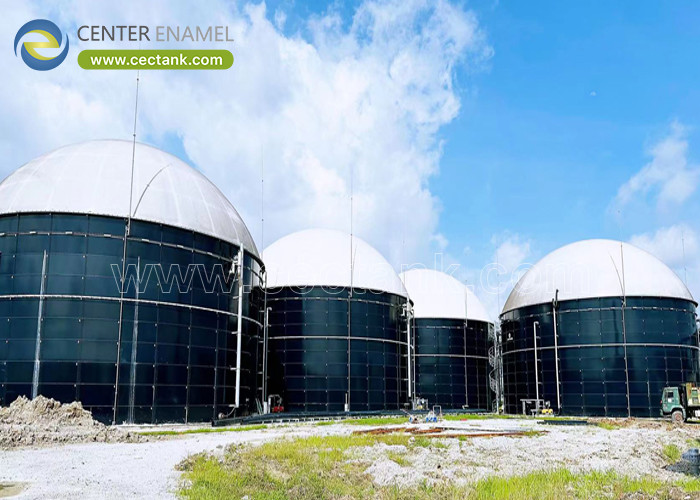
Grain is harvested in weeks and consumed across the year — which is why storage, not production, decides how much of the harvest reaches market. Poor storage loses value in every form: moisture migrates and molds, insects breed in warm grain masses, birds and rodents raid open storage, and condensation rusts weak structures from the inside out. The choice of silo system, and how it is engineered, determines whether a harvest appreciates or decays.
Grain silos from Shijiazhuang Zhengzhong Technology Co., Ltd (Center Enamel) are bolted steel storage systems engineered for the commodity and the climate: flat-bottom and hopper-bottom configurations, sealed and aeratable envelopes, temperature monitoring, and EN 1090 certified manufacturing — delivered to more than 100 countries since 2008.
The two structural decisions — geometry and material — define the silo's behavior, cost, and service life.
Grain preservation is environmental control — and it is delivered by three engineered systems working together.
Silo selection follows the commodity's density, the operation's turnover, and the site's climate and growth plan.
| Evaluation Criterion | Bolted Steel Silo (Center Enamel) | Concrete Silo | Bag / Flat Storage |
|---|---|---|---|
| Moisture & pest protection | High — sealed envelope, engineered roof | Moderate — cracks, condensation, sweating | Poor — exposed, high losses |
| Construction speed | Fast — factory panels, bolted in weeks | Very slow — months of casting | Fast to start, ongoing losses |
| Corrosion resistance | High — coated shells resist condensation | N/A — cracks instead | N/A |
| Aeration & monitoring | High — aeration + zone temperature sensors | Moderate — condensation harms grain | None |
| Scalability | High — add cells, relocate | None | Low — expanding losses |
| Lifecycle cost | Low — 30+ year coated structure | High — repairs, moisture damage | Worst — harvest value lost |
Every Center Enamel grain silo is engineered for its commodity and site — wind, seismic, and discharge loads FEA-verified — and manufactured under ISO 9001 and EN 1090 certified systems, with export delivery and installation support across more than 100 countries.
A silo is not a container; it is a climate machine. The envelope keeps the weather out, the aeration keeps the grain uniform, and the sensors keep the operator informed — and all three only work when the steel is engineered, coated, and sealed in the factory.
Grain silos store cereal grains — wheat, corn, rice, soybeans, and barley — between harvest and use or sale, protecting them from moisture, pests, and temperature swings. Flat-bottom silos suit long-term reserve; hopper-bottom silos suit fast-turnover handling.
Flat-bottom silos maximize capacity for large single-commodity volumes and empty with sweep augers; hopper-bottom silos self-empty by gravity, suiting daily throughput, blending, and first-in/first-out inventory control.
Bolted steel is factory-manufactured to EN 1090 quality, erects in weeks, resists condensation corrosion with coated shells, and can be expanded or relocated. Concrete takes months, cracks and sweats, and cannot be moved.
Yes — capacity, flat or hopper geometry, aeration and monitoring packages, sealing level, and handling interfaces are engineered per commodity density, turnover, and site wind/seismic conditions, from farm cells to commercial terminals.