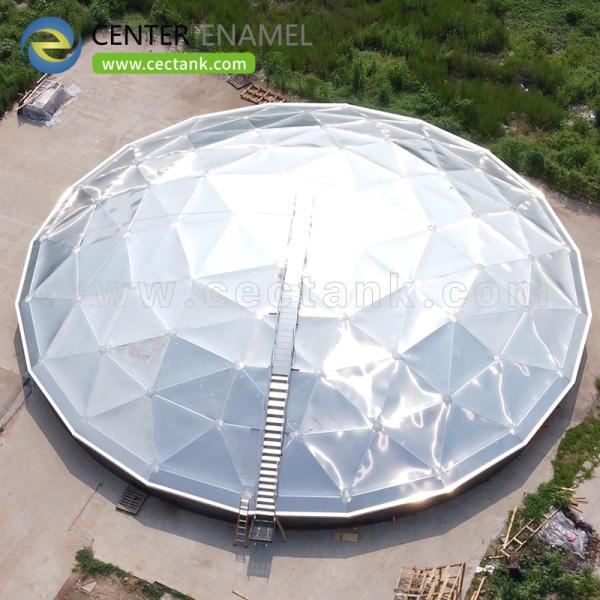
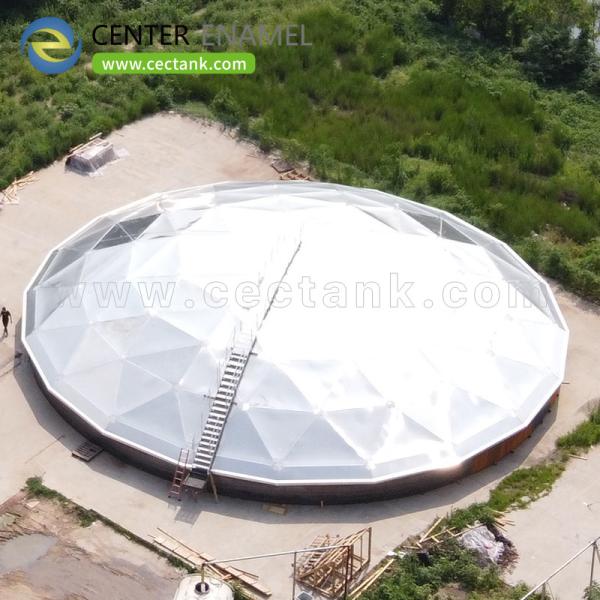
In industrial, municipal, and petrochemical infrastructure, the enclosure of storage vessels is critical for environmental compliance, product purity, and structural longevity. The Aluminum Geodesic Dome Roof (ADR) has emerged as the definitive global standard for aboveground storage tank (AST) protection, replacing traditional heavy steel and concrete structures with a lightweight, corrosion-resistant, and self-supporting geometric lattice.
This guide provides a technical overview of geodesic technology, its operational advantages, and the global compliance standards that govern its deployment.
A geodesic dome is a spherical structure composed of a network of interlocking triangles. This design relies on the inherent structural efficiency of the triangle—the only polygon that is rigid and stable within itself without requiring additional reinforcement at the joints.
● Self-Supporting Clear Span: Unlike traditional roofs that require central columns, rafters, or trusses, the geodesic dome is entirely self-supporting. It transfers all structural loads (wind, snow, and live loads) to the tank perimeter.
● Load Distribution: When pressure or weight is applied to any point on the dome, the force is distributed equally across the triangular lattice. This allows for massive clear spans (up to 1,000+ feet) with minimal material weight.
● Tension-Based Integrity: Modern domes utilize tension to prevent the structure from spreading. The network of extruded aluminum struts, hubs, and gusset plates creates a stable system that is rigid and resistant to distortion.
Engineering procurement managers prioritize aluminum domes due to their superior lifecycle performance compared to welded steel or concrete alternatives.
|
Engineering Parameter |
Aluminum Geodesic Dome |
Welded Steel Roof |
|
Corrosion Resistance |
High (Inherent). Does not rust; requires no painting or recoating. |
Low. Requires periodic sandblasting and protective coating. |
|
Internal Supports |
None. Clear-span architecture. |
Required. Columns prone to internal corrosion. |
|
Weight |
Ultra-Lightweight. Minimizes load on tank foundation/shell. |
High. Adds significant structural dead weight. |
|
Maintenance |
Minimal. "Fit-and-forget" solution. |
High. Requires frequent inspection and repairs. |
|
Asset Service Life |
40–50+ Years. |
20–25 Years. |
● Emission Control (VOC Mitigation): In petroleum and chemical storage, aluminum domes act as a "gasketed shield," significantly reducing Volatile Organic Compound (VOC) emissions by containing vapors and preventing evaporation.
● Water Quality Protection: In municipal potable water systems, these domes provide a hermetic seal against bird droppings, dust, and UV radiation, which are primary drivers of algal blooms and water degradation.
● Retrofit Capability: Due to their low weight, these domes are the preferred solution for retrofitting existing tanks that were originally designed without roofs, as they impose negligible extra force on the existing shell.
● Safety & Installation Speed: Domes are typically assembled on the ground using modular components and then hoisted into place, or built top-down. This eliminates the need for internal scaffolding and "hot work" (welding) during installation, drastically improving site safety.
To ensure safety and structural integrity under extreme environmental loads, geodesic dome roofs must be engineered in accordance with rigorous international codes.
● AWWA D108: The American Water Works Association standard governing the design, construction, and installation of aluminum dome roofs specifically for water and wastewater infrastructure.
● API 650 (Appendix G): The industry standard for aluminum geodesic domes used in the petroleum and petrochemical storage industries.
● ASCE 7: Governs minimum design loads and associated criteria for buildings and other structures, including wind, snow, and seismic load analysis.
● ISO 9001 & EN1090: Mandates rigorous quality management and structural steel/aluminum conformity during fabrication.
Aluminum dome roofs are versatile assets deployed across mission-critical industries:
1. Potable & Wastewater Treatment: Protects water supply from environmental ingress while offering a maintenance-free enclosure for clarifiers and basins.
2. Petrochemical & Refining: Controls hazardous emissions, prevents rain/snow ingress into floating roof systems, and preserves product quality.
3. Bulk Dry Storage: Provides high-clearance, column-free protection for agricultural grains, mining minerals, and industrial raw materials.
Modern domes utilize a mechanical Batten Method. Raw edges of the aluminum panels are clamped by batten bars and secured with high-performance gaskets. This creates a fully weather-tight, gasketed shield that protects against leaks, ponding, and sealant degradation caused by UV exposure.
Yes. Because the construction does not require hot work and can often be performed by lifting the pre-assembled dome onto the tank, the process is significantly faster and safer than traditional roof construction, often allowing for operational continuity.
The geodesic design, combined with high-strength, marine-grade aluminum alloys (typically 5000 and 6000 series), allows for custom engineering based on local site conditions. Finite Element Analysis (FEA) is utilized during the design phase to ensure the roof meets site-specific structural load requirements.
If you are evaluating an infrastructure project, would you like to compare the structural load-bearing capabilities of aluminum versus steel for your specific tank diameter?