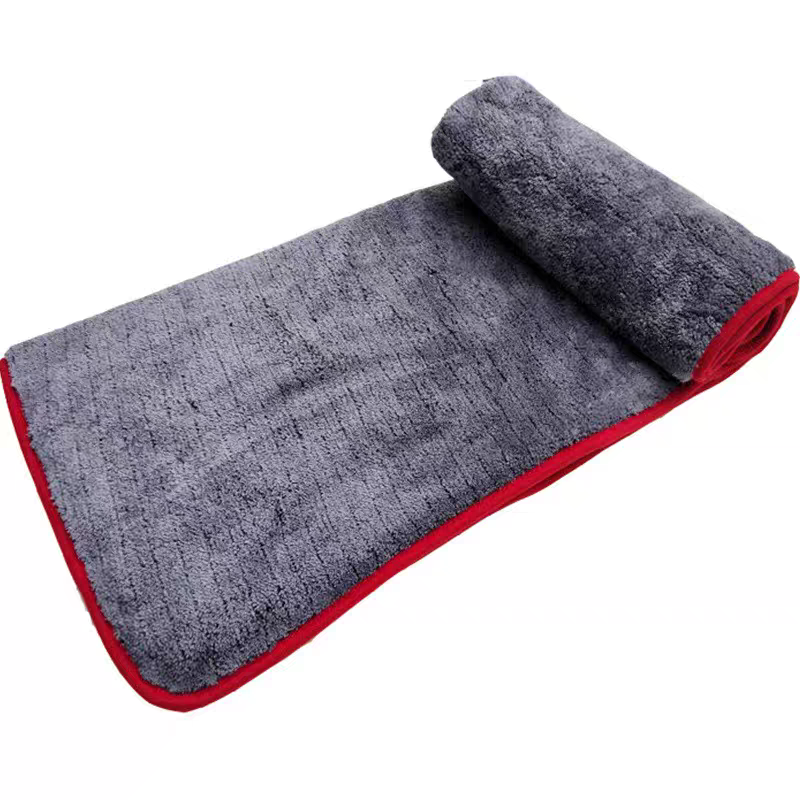
A cationic towel is not a towel made of a single material, but a functional fabric crafted from cationically modified fibers through special processing techniques. Its core technology lies in the "cationic treatment" of the fiber surface—chemically modifying the fibers to carry a positive charge, which alters the fibers' physical structure and surface properties, ultimately endowing the towel with unique performance that sets it apart from ordinary towels. Such towels are commonly used in scenarios like car cleaning, home care, and personal hygiene, especially in fields with high requirements for material softness, water absorption, and durability.

Cationic modification changes the molecular structure of the fibers, making the fiber diameter thinner (usually < 0.3 denier, 30%-50% thinner than ordinary microfibers). Additionally, a smooth "film-like structure" forms on the fiber surface, free of rough fuzz. When touched by hand, one can clearly feel a fluffy and smooth texture similar to "clouds," without the stiffness or roughness of ordinary towels (especially cotton towels). It is gentler when in contact with the skin or delicate surfaces (such as car paint or solid wood furniture surfaces) and less likely to cause friction discomfort.
The chemical modification of cationic fibers increases the "hydrophilic groups" in the fibers. At the same time, their unique weaving process (mostly a three-dimensional fluffy structure) creates a large number of tiny "air chambers" between the fibers. These air chambers act like "micro water storage tanks," quickly absorbing water and locking it firmly in place, preventing rapid water loss due to squeezing or hanging. Data shows that the water absorption speed of cationic towels is 20%-30% faster than that of ordinary cotton towels. They can absorb 6-8 times their own weight in water, and after absorbing water, they are less likely to "droop damply," making them more convenient for wiping.
Ordinary towels (especially cotton or low-quality microfiber towels) tend to "shed lint" due to loose fiber bonding and falling fuzz. Cationic towels solve this problem through two key measures:
During the cationic treatment process, the "positive charge" on the fiber surface forms a stronger binding force with the "negative charge" of dye molecules, allowing the dye to adhere more stably to the fibers. Compared with ordinary towels, cationic towels have higher color fastness (especially wash fastness and rub fastness):
Cationic fibers themselves have good tensile resistance and shrinkage resistance. Combined with a special weaving process, the overall structure of the towel is more stable:
Cationic towels have good resistance to common cleaning agents (such as dish soap, laundry detergent, car wash liquid, and furniture care agents). They will not experience issues like "fiber corrosion, hardening, or reduced water absorption" due to contact with these chemicals. This feature makes them applicable to a wider range of scenarios: they can be used as household cleaning towels (for wiping tableware and furniture) and also as professional cleaning towels (such as car wash towels and laboratory cleaning towels), without worrying about material damage caused by chemicals.