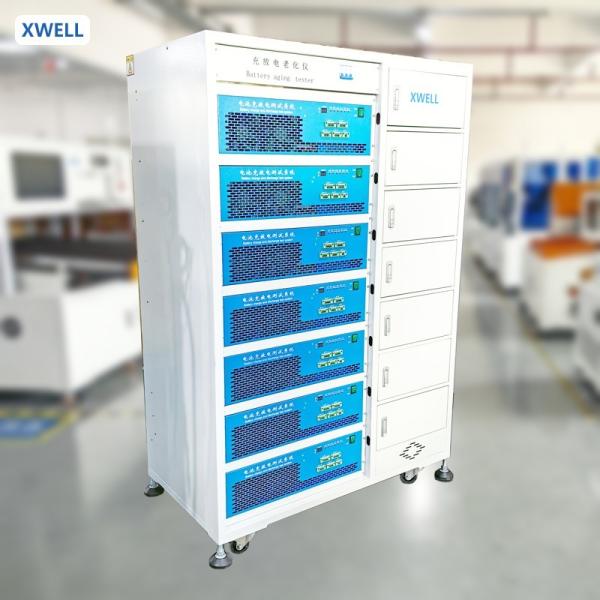
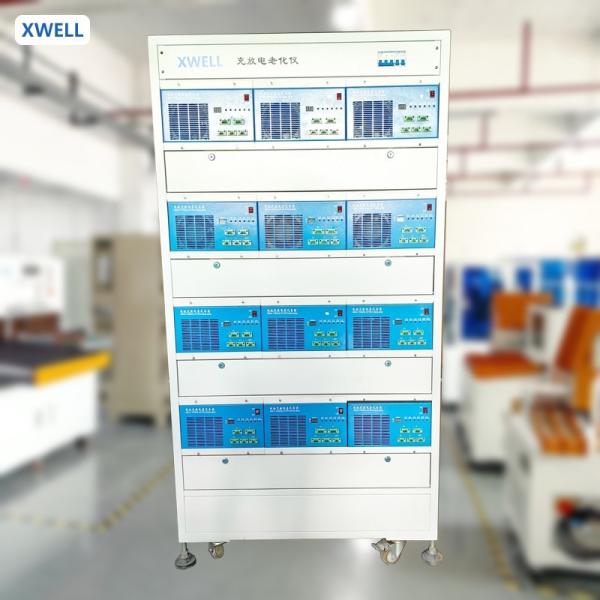
XW-100V100A6CH Battery Charge and Discharge Aging Machine
Product Overview
The XW-100V100A6CH is a 6-channel battery charge and discharge aging machine designed for lithium battery pack testing in applications such as power tools, solar energy storage systems, self-balancing scooters, electric bicycles, electric motorcycles, and home energy storage. Each of the six channels operates independently, supporting parallel output configurations to accommodate varied testing workflows within a single equipment cabinet measuring 920*690*847mm (W*D*H).
This system integrates cyclic charge and discharge testing, battery function verification, and real-time charge/discharge data monitoring into a unified platform. A three-level control architecture—host computer, intermediate computer, and bidirectional ACDC with LLC isolated DCDC—manages equipment operation, data processing, and energy flow. The intermediate computer executes calculations for battery capacity and state of charge (SOC), while the host computer provides the primary human-machine interface for test initiation, monitoring, and data export.
The equipment operates from a three-phase five-wire AC 380V supply at 50Hz, with a maximum power rating of 60KW per cabinet. The power stage employs bidirectional ACDC conversion using space vector modulation and digital control, achieving a power factor exceeding 0.99 at rated load and total harmonic distortion (THD) below 3%. During discharge cycles, energy is fed back to the grid through the bidirectional power path, with a bus feedback efficiency of 93%.
Product Features
- 6-Channel Independent Operation: Each channel functions as an independent test unit with dedicated DCDC module, supporting simultaneous testing of six battery packs under individually configured charge and discharge parameters. Channels also support parallel output for higher current requirements.
- 100V / 100A Testing Capability: Voltage measurement range covers 10–100V, suitable for battery packs of 3S and above. Current range extends from 0.1A to 100A for both charging and discharging, with a CV cutoff current as low as 50mA for precise end-of-charge detection.
- Four-Wire Kelvin Sampling: High-precision voltage and current measurement employs four-wire sampling topology, maintaining long-term measurement stability and minimizing the influence of lead resistance on data accuracy.
- Bidirectional Energy Feedback Design: The bidirectional ACDC + LLC isolated DCDC architecture enables discharge energy to be returned to the AC grid rather than dissipated as heat. DC bus feedback efficiency reaches 93%, and system charging efficiency measures 88%.
- Seamless CC/CV Transition: Advanced PID regulation in the DCDC modules ensures smooth switching between constant-current and constant-voltage modes without voltage or current spikes, preventing battery overheating and electrode tab damage during mode transitions.
- Comprehensive Test Function Suite: The system supports cycle life testing, capacity testing, charge/discharge characteristic analysis, charge retention evaluation, efficiency measurement, and overcharge/overcharge rate testing within a single platform.
- 10000-Cycle Program Capability: Test programs can be configured for up to 10,000 charge/discharge cycles, supporting long-duration battery aging and life cycle evaluation protocols without manual intervention.
- Barcode and Traceability Integration: The software supports battery barcode input and maintains historical test data traceability, enabling correlation between individual battery packs and their complete test records across production batches.
- Dual-Channel Internal Energy Conversion: The system can transfer energy between two channels internally, optimizing power consumption during simultaneous charge and discharge operations on different battery packs.
- Multi-Format Data Export: Test results can be exported in Excel and chart formats. Available curve outputs include voltage vs. time, current vs. time, capacity vs. time, capacity fade trends, and cycle life plots. Data storage paths and file names are user-configurable.
- LAN Communication: TCP/IP-based LAN connectivity enables integration with factory network infrastructure for remote monitoring and centralized data management.
- Forced Air Cooling System: The cabinet employs forced air cooling to maintain stable internal operating temperatures, supporting continuous operation in ambient conditions ranging from -10°C to 45°C.
Working Principle
The XW-100V100A6CH operates through a three-tier control and power conversion architecture. At the top level, the host computer software serves as the primary human-machine interaction interface, managing equipment commands such as start, stop, pause, and continue. Battery aging data is collected, processed, and archived by the host computer, which also generates the required test result outputs including capacity calculations, efficiency metrics, and life cycle degradation curves.
The intermediate computer functions as the central control management layer, executing computational tasks including battery capacity determination and state of charge (SOC) estimation. This middle layer coordinates data flow between the host interface and the power conversion hardware, ensuring synchronized operation across all six channels.
Power conversion employs a two-stage topology. The first stage consists of a bidirectional ACDC converter with LLC isolated DCDC, which during charging draws power from the three-phase AC grid, conditions it through the bidirectional DCDC, and delivers the programmed voltage and current to the connected battery pack. During discharge, this same stage reverses direction, feeding energy from the battery back to the AC grid via the bidirectional power path. The second stage uses non-isolated bidirectional DCDC (Buck/Boost) modules—one per channel—to deliver the precise voltage and current values required for constant-current charging, constant-voltage charging, and constant-current discharging.
The system supports four working modes: constant-current (CC) charging, constant-voltage (CV) charging, constant-current constant-voltage (CCCV) combined charging, constant-current discharging (CD), and constant-voltage discharging (CVD). High-frequency isolation separates the entire system from the power grid, ensuring safe and stable operation across all channels.
The current hardware response time is within 20ms, and the minimum data logging interval is 1 second. Recorded parameters for each channel include voltage, current, time, capacity, and energy, providing a complete dataset for battery performance analysis and quality grading decisions.
Product Advantages
- Independent 6-channel architecture with parallel output support for flexible test configuration
- Bidirectional power topology routes discharge energy back to the grid at 93% bus efficiency
- Four-wire Kelvin measurement delivers ±0.1% F.S ±0.1% F.D accuracy on both voltage and current channels
- 100V / 100A per channel capability covers a wide range of lithium battery pack configurations
- 10,000-cycle program capacity supports extended aging and life cycle evaluation protocols
- Seamless CC/CV switching controlled by advanced PID regulation eliminates transition spikes
- High-frequency galvanic isolation separates the entire test system from the AC mains
- Dual-channel internal energy exchange reduces overall power consumption during mixed charge/discharge operations
- Hardware current response within 20ms ensures accurate tracking of dynamic test profiles
- Barcode-enabled traceability links individual battery packs to complete historical test records
- Multi-level software protection includes power-off data retention and automatic test resumption
- Compact single-cabinet design (920*690*847mm) integrates power, control, and 6 test channels
Technical Specifications
AC Input
| Supply Type | Three-phase five-wire AC 380V |
| Frequency | 50Hz |
| Input Current | 107A (125A-3P breaker recommended) |
| Total Harmonic Distortion (THD) | ≤3% |
| Power Factor | >0.99 (rated load) |
| Charging Efficiency (System) | 88% |
| Bus Feedback Efficiency | 93% |
Measurement & Control
| Voltage Measuring Range | 10–100V (3S or more batteries) |
| Voltage Accuracy | ±0.1% of F.S ±0.1% of F.D |
| Charging Current Range | 0.1–100A |
| Discharging Current Range | 0.1–100A |
| Current Accuracy | ±0.1% of F.S ±0.1% of F.D |
| CV Cutoff Current (Min.) | 50mA |
| Capacity Accuracy | ±0.1% of F.S ±0.1% of F.D |
| Current Hardware Response Time | ≤20ms |
| Data Logging Interval | ≥1s |
System Configuration
| Channels per Cabinet | 6 |
| Number of Cabinets | 1 |
| Max. Power per Cabinet | ≤60KW |
| Working Modes (Charge) | CC, CV, CCCV |
| Working Modes (Discharge) | CD, CVD |
| Communication | LAN (TCP/IP) |
| Max. Cycle Times | 10,000 cycles |
| Cooling Method | Forced air cooling |
| Cabinet Dimensions | 920*690*847mm (W*D*H) |
| Ambient Temperature Range | -10~45℃ |
System Functions
| Test Functions | Cycle life test, capacity test, charge/discharge characteristics, charge retention, efficiency test, overcharge/overcharge rate test |
| Recorded Data | Voltage, current, time, capacity, energy |
| Data Export Formats | Excel, charts (voltage/current/capacity vs. time, capacity fade, cycle life) |
| Data Storage | Customizable file names and paths; file-based storage |
Protection Functions
| Input Protection | Overvoltage, overcurrent, phase loss, over-temperature, alarm, anti-islanding |
| Output Protection | Overvoltage, overcurrent, phase loss, over-temperature, alarm, anti-islanding |
| Software Protection | Power-off data retention, power-on resume, over/under voltage/current protection, capacity protection, over-temperature protection, abnormal voltage/current trend/rise/fall protection |
| Additional Safety | Reverse connection protection, safe discharge current protection, high-frequency grid isolation |
Main Configuration
| No. | Component | Brand | Quantity | Unit |
|---|
| 1 | Main Control Board | In-house | 6 | pcs |
| 2 | Main CPU | TI (USA) | 6 | pcs |
| 3 | Communication Module | In-house | 1 | pc |
| 4 | Relay | Hongfa | 18 | pcs |
| 5 | Power Supply | Lorenz / Tuwei | Configured by power | pc |
| 6 | Earth Leakage Circuit Breaker | Chint | 1 | pc |
| 7 | Cabinet | In-house | 1 | pc |
| 8 | Software System | In-house | 1 | set |
Application Industries
- Power tool battery pack manufacturing and quality testing
- Solar energy storage system battery testing and aging
- Self-balancing scooter battery pack cycle life evaluation
- Electric scooter battery charge/discharge characteristic analysis
- Electric bicycle battery capacity and retention testing
- Electric motorcycle battery pack performance validation
- Home energy storage battery system aging and qualification
- Lithium battery pack research and development laboratories
- Third-party battery testing and certification service providers
- Battery pack production line end-of-line testing stations
Why Choose This Machine
The XW-100V100A6CH addresses a specific testing requirement that single-channel or low-power systems cannot fulfill: simultaneous multi-channel testing of lithium battery packs up to 100V with charge and discharge currents reaching 100A per channel. The six independent channels, each driven by a dedicated DCDC module with TI main CPU control, allow production facilities to run distinct test protocols on different battery pack models concurrently, maximizing equipment utilization without cross-channel interference.
The bidirectional energy feedback architecture represents a practical consideration for continuous production operation. Rather than dissipating discharge energy as heat—which would increase cooling load and facility power consumption—the system returns discharge energy to the AC grid with 93% bus feedback efficiency. This design reduces the net energy consumption of long-duration aging cycles, where battery packs undergo repeated charge and discharge sequences over extended periods.
Measurement integrity is maintained through four-wire Kelvin sampling on each channel, achieving ±0.1% F.S ±0.1% F.D accuracy on both voltage and current measurements. This accuracy level supports reliable capacity determination and cycle life trending, providing the data resolution required for quality grading decisions in battery pack production environments. The 1-second minimum data logging interval captures detailed charge and discharge profiles, while the 20ms hardware current response time ensures the system tracks dynamic test conditions without measurement lag.
For production traceability, the barcode input function and historical data storage system link each battery pack to its complete test record. This capability supports quality documentation requirements and enables retrospective analysis of test data when investigating field performance or warranty claims. Standard accessories include test leads, connection tools, user manual, and host computer software. Users supply a PC for test software; XWELL technical personnel provide software installation and operational training.
FAQ
Q1: What battery pack voltages can the XW-100V100A6CH test?
The equipment supports a voltage measurement range of 10–100V, corresponding to battery packs of 3S and above in series configuration. The constant-voltage charging range operates within this 10–100V window, and the CV cutoff current can be set as low as 50mA for precise end-of-charge detection.
Q2: Can all six channels operate simultaneously with different test parameters?
Yes. Each of the six channels operates independently with its own DCDC module and PID control loop. Different test programs with distinct charge/discharge currents, voltage limits, cycle counts, and cutoff conditions can run on each channel simultaneously. Channels also support parallel output for applications requiring current beyond 100A per channel.
Q3: What happens to test data if a power failure occurs during a cycle?
The system includes power-off data retention and automatic power-on resume functionality. When AC power is restored, the equipment continues the test workflow from the interruption point. Software-level protection covers over/under voltage, over/under current, capacity, over-temperature, and abnormal voltage/current trend conditions, with corresponding protective actions configured per test program.
Q4: How is the discharge energy managed? Does the system require external load banks?
The XW-100V100A6CH does not require external load banks for discharge. The bidirectional ACDC + LLC isolated DCDC topology feeds discharge energy back to the AC grid rather than dissipating it as heat. The DC bus feedback efficiency is 93%, and the overall system charging efficiency is 88%. This design eliminates the need for resistive load banks and their associated cooling infrastructure.
Q5: What data export and analysis capabilities does the system provide?
Test data can be exported in Excel format and as graphical charts. Available curve types include voltage vs. time, current vs. time, capacity vs. time, capacity fade over cycles, and cycle life plots. Users can configure custom file names and storage paths. The host computer archives all recorded parameters—voltage, current, time, capacity, and energy—for each channel at the configured logging interval (minimum 1 second).
GUANGDONG XWELL TECHNOLOGY CO., LTD.
Website: https://xwellcn.com | Email: sales@xwellcn.com
TEL / WhatsApp / WeChat: +86-18620492985
Address: Room 316, Building 3, No. 801, Qiaoxing Avenue, Xiaoluo Village, Shatou Street, Panyu District, Guangzhou