| Auger types | Single/Twin/Multi screw |
| Heated/Cooled shaft | |
| Hollow flights | |
| Ribbon or cut flighting | |
| Instrumenation | Temperature in/out readout |
| Flowmeters | |
| Variety of pressure gauges available | |
| Customized control panels | |
| Seal types | Rotating Mechanical |
| Packing Gland | |
| Custom | |
| Heaters/ Coolers | Single, dual or triple zone configurations |
| -50oF to 600oF temperature control | |
| Designed for your needs | |
| Jacket types | Heating jackets |
| Cooling jackets | |
| Integral or bolt-on | |
| ASME "U" and "R" stamp | |
| Customization | Inlet and outlet custom designs |
| Built-to-order support stands | |
| NDE and X-ray options | |
| Various insulation options | |
| Sample applications | Drying |
| Polymerzation | |
| Heat curing | |
| Cooling/ freezing | |
| Microbial kill | |
| Sintering/ calcining | |
| Dewatering |
Product Description:
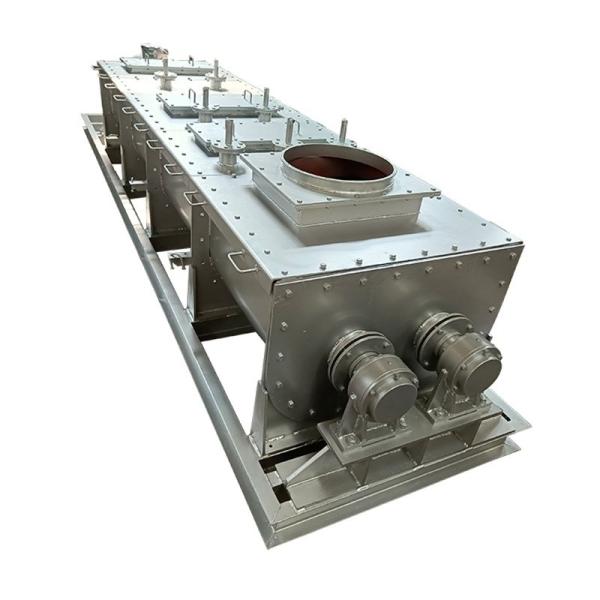
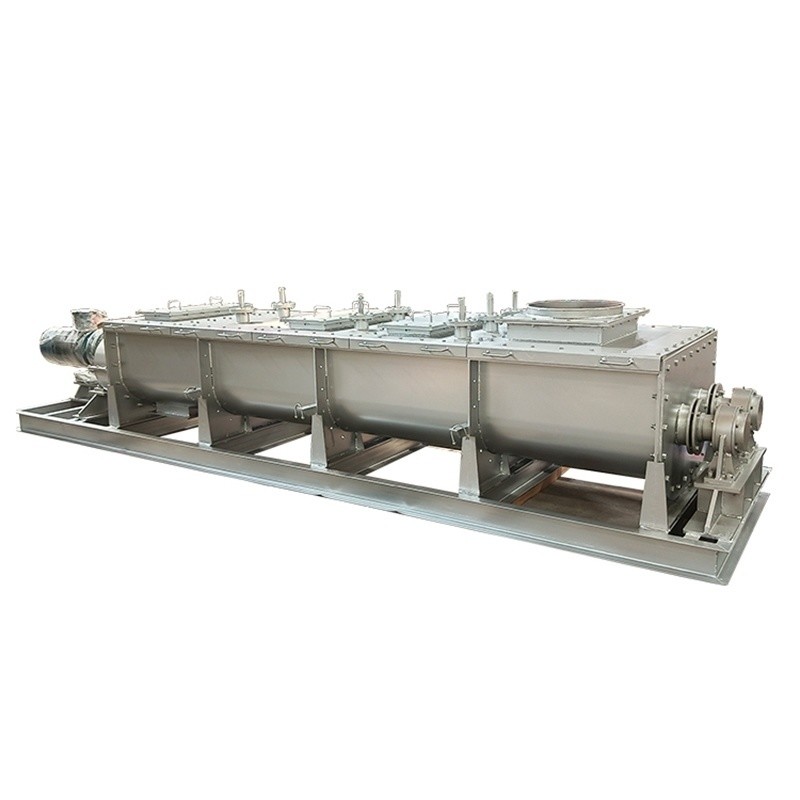
Heat Systems screw conveyors are simple, robust and flexible, often employed to adjust the temperature of a solid material prior to storage or further processing. The unit is essentially a screw conveyor with heat transfer capability, providing both material movement and temperature adjustment in one device.
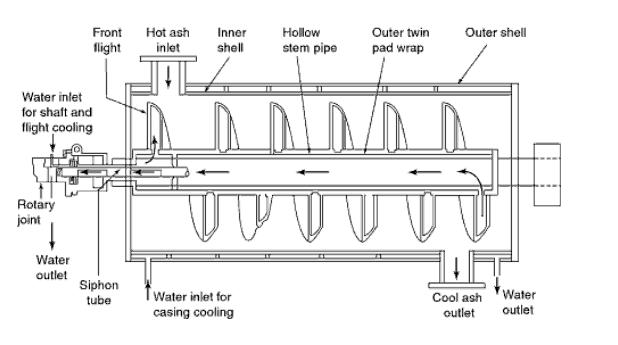
Other suppliers typically employ an external jacket to act as the sole heat transfer surface. The problem is that this surface has limited contact with the material due to voidage and movement, generally resulting in a larger unit than necessary being specified to compensate. However, the Heat Systems screw conveyors also use the screw itself to supply or withdraw heat, thereby penetrating deep into the solid which is often a poor conductor (e.g. spent carbon). This effectively results in a smaller, more compact footprint and cost.
A liquid heat transfer medium ensures stable and precise control of the final product temperature (e.g. cooling water, thermal oil, glycol etc). As always, custom screw conveyor designs are available to suit your individual need.
Features:
Thermal treatment is accomplished while the product material is conveyed for cost savings;
Control of temperature during material transfer for maximum efficiency;
Accurate control of thermal treatment time ensures precise requirements are met;
Greater heat transfer surface area per unit of product than batch mixer systems;
Bolt-on or integral external thermal heating and cooling jacket.
Advantages:
Efficient Heat Transfer
The thermascrew provides full heat surface utilization with both a heated vessel and rotor. The rotor's short-pitch screw design promotes gentle material tumbling, promoting more uniform and efficient heat transfer.
Residence Time Control
Near plug-flow operation means consistent time and temperature exposure for treating material and providing controlled, narrow residence time distribution.
Minimize Processing Damage
Even treatment and slow mixing action minimizes burning, sticking, abrasion, dusting, crushing, or breaking.
Thick Material Processing
Twin-rotor designs are available to process difficult, dough or paste-like materials. Intermeshing flights on the rotor helps promote more even heat-transfer while preventing sticking and promoting self-cleaning.
Steam Injection
Optional injection capabilities inject steam into the material for cooking or sterilizing applications.
Operating Cost Savings
Material is heated, cooled, mixed, or dried as it is conveyed, resulting in lower costs, increased efficiency and no product damage or spillage.
Application:
Heating and cooling screw conveyors are used around the globe in industries such as biomass conversion, paper and pulp, biofuels, food and dairy, chemicals, petrochemicals, minerals processing, and many more.
Drawing: