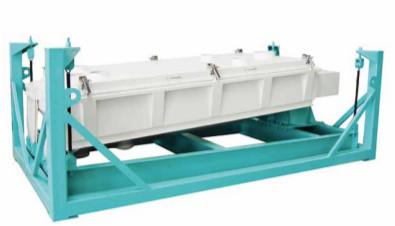
Large Capacity Rota-Shake Sifter Vibration Screen Feed Production Equipment
Performance Features
- Steady and reliable operation
- Optimized sieve structure for rapid and easy sieve changes
- Special balancing method reduces vibration with imported SKF bearings for low noise and stable transmission
- Integrates circular motion, ellipse motion, and reciprocating linear motion characteristics for large capacity, high sieving efficiency, and low energy consumption
Technical Parameters
| Model |
SWHFS100 |
SWHFS125 |
SWHFS150 |
SWHFS180 |
| Screen Size (mm) |
1000×2130 |
1250×2400 |
1500×2800 |
1800×3200 |
| Number of Layers |
3 |
3 |
3 |
3 |
| Size of Hole (Mesh) |
Upper screen 2 mesh, middle screen 6 mesh, lower screen 12 mesh |
| Power (kW) |
2.2 |
3 |
4 |
5.5 |
| Capacity (t/h) |
10 |
15 |
20 |
30 |
Common Problems and Corrective Actions
1. Uneven Material Distribution on the Upper Screen
Possible Causes
- Improper inlet position adjustment
- Incorrect position of the material distribution plate
- Wrong motor rotation direction
Solutions
- Adjust the feeding inlet position
- Adjust the material distribution plate
- Ensure the two vibration motors rotate in opposite directions
2. Excessive Material on the Upper Screen
Possible Causes
- Excessive feeding volume
- Screen mesh blockage
- Screen hole size too small
Solutions
- Reduce feeding quantity
- Clean the screen surface regularly
- Replace with a larger mesh size if necessary
3. Excessive Good Material in Oversized Discharge
Possible Causes
- Feeding volume too high
- Screen blockage
- Screen hole size too small
- Vibration direction angle too small
Solutions
- Adjust feeding rate
- Clean blocked screen mesh
- Use a larger screen opening
- Increase the vibration direction angle
4. Excessive Impurities in Fine Material
Possible Causes
- Lower screen mesh opening too large
- Damaged screen mesh
- Poor sealing between screen frame and screen body
Solutions
- Replace damaged screen mesh
- Select suitable mesh size
- Check and eliminate sealing gaps
5. Abnormal Noise Inside the Machine
Possible Cause
- Loose screen frame locking structure
Solution
- Tighten all fastening components
6. Reduced Amplitude or Abnormal Vibration
Possible Causes
- Worn or aged rubber springs
- Damaged vibration motor bearings
- Two motors rotating in the same direction
Solutions
- Replace rubber springs
- Replace motor bearings
- Ensure motors rotate in opposite directions
7. Material Does Not Move Forward Properly
Possible Causes
- Incorrect motor rotation direction
- Small screen inclination angle
- Insufficient vibration amplitude
Solutions
- Adjust motor rotation direction
- Increase screen inclination angle
- Adjust vibration amplitude properly
8. Low Screening Capacity
Possible Causes
- Improper vibration direction angle
- Slow material movement speed
- Poor screening efficiency
Solutions
- Adjust vibration motor angle
- Optimize material flow speed
- Balance screening efficiency and production capacity