Aquatic Animal Feed Additive Magnesium Amino Acid Chelate 10% Customized for Shrimp
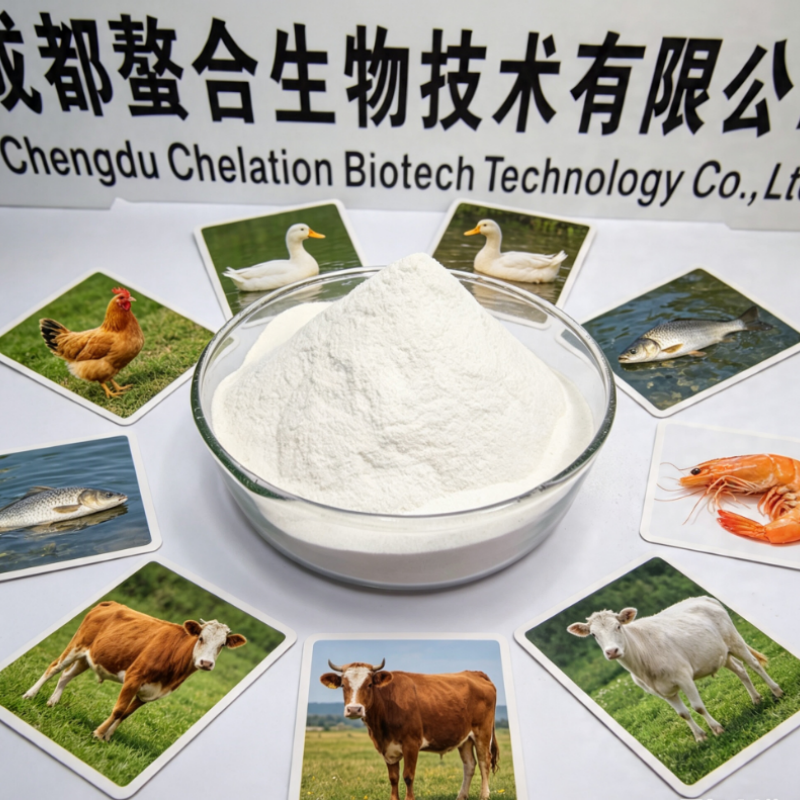
Magnesium Amino Acid Chelate appears as a white/almost white, flowable powder, easily soluble in water and slightly soluble in ethanol. It is chemically stable at room temperature and is not prone to forming insoluble precipitates with phytic acid, oxalic acid, etc. in feed.
Its core advantage lies in its bioavailability, which is significantly higher than that of inorganic magnesium salts (magnesium oxide,). It can be directly absorbed through the amino acid transport system, reducing antagonism and waste.
Amino Acid Chelated Magnesium is a highly efficient organic magnesium feed additive. With superior stability and bioavailability compared to inorganic magnesium , it plays vital roles in the culture of shrimp.
Specification
| Appearance |
off white powder |
| Moisture |
≤12% |
| Crude protein |
20%min |
| Mg |
10%min |
| Pb |
≤20ppm |
| As |
≤5 ppm |
Functions
1. High-Efficiency Magnesium Supplementation & Improved Absorption
- Forms a stable cyclic chelate structure between Mg²⁺ and amino acids, preventing precipitation with phosphates, carbonates, etc., in water and digestive tract; excellent water solubility and low leaching loss.
- Absorbed via active amino acid transport pathways in the shrimp gut, with absorption rate 1.25–2.5 times higher than inorganic magnesium, significantly enhancing tissue magnesium deposition.
2. Critical for Molting & Exoskeleton Hardening (Reduces Soft Shell & Mortality)
- Essential structural component of the shrimp exoskeleton (second only to calcium), involved in calcification and chitin synthesis.
- Pre-molt: Regulates osmotic pressure for successful molting.
- Post-molt: Accelerates new cuticle hardening, shortens the vulnerable soft-shell stage, and reduces soft-shell syndrome and molting failure mortality.
- Promotes calcium utilization and maintains optimal Ca:Mg ratio (~1:3) for a rigid, glossy exoskeleton.
3. Boosts Energy & Nutrient Metabolism, Improves Growth & FCR
- Acts as a cofactor for hundreds of enzymes (ATPase, hexokinase, etc.), driving carbohydrate, lipid, and protein metabolism and cellular energy (ATP) production.
- Enhances feed intake, digestibility, and feed conversion ratio (FCR), promoting weight gain and growth performance.
- Participates in protein and nucleic acid synthesis for tissue growth and repair.
4. Maintains Neuromuscular Function & Enhances Stress Resistance
- Ensures normal cell membrane potential, nerve impulse transmission, and muscle contraction, reducing cramps, tetany, and stress-related mortality.
- Improves tolerance to environmental stressors: salinity fluctuations, low DO, high density, handling, and transport.
- Stabilizes ionic and acid-base balance, supporting gill osmoregulatory function.
Reference for addition amount:
3-6kg/ton of compound feed, with specific reference to nutritionists, biological species, growth period, and other factors for flexible application.
Packaging
20 kg/bag
Storage
Dry, ventilated, rainproof, and sun proof
Shelf life
12 months