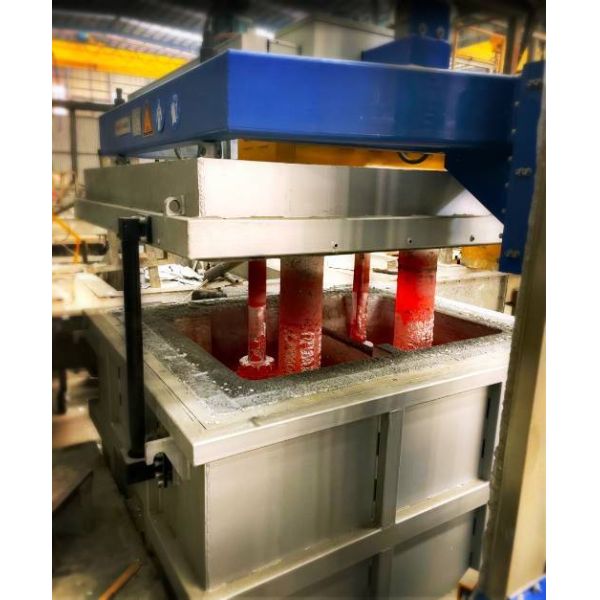
Product: Online Degassing Unit
Assembly Components & Key Features:
Mechanical Drive System
High-precision geared motor drive
Robust transmission mechanism ensuring stable rotor operation
Degassing Chamber & Cover
Refractory-lined chamber for thermal efficiency and longevity
Quick-seal cover design for easy maintenance and gas containment
Rotor & Heating System
High-speed graphite rotor for efficient gas dispersion
Integrated heater with temperature control for optimal melt processing
Electrical Control System
PLC-based automated control panel
Real-time monitoring of parameters (temperature, speed, processing time)
User-friendly HMI (Human-Machine Interface) for easy operation
Parameters of Online Degassing unit:
| Max Degassing flow MT/H | 15 MT/H | 35 MT/H | 65 MT/H |
|---|---|---|---|
| Degassing Box Standard | 1 room 1 rotor (1B1R) | 2 rooms 2 rotors(2B2R) | 3 rooms 3 rotors(3B3R) |
| Degassing box structure | 1 draining outlet & 1 deslagging outlet | 2 draining outlets & 1 deslagging outlet | 3 draining outlets 1 deslagging outlet |
| Lifting System | Hoisting type | Rotor mechanical lifting | cover hydraulic lifting |
Online Degassing Unit: Performance & Working Principle
Primary Function:
The Online Degassing Unit is designed to efficiently remove hydrogen (H₂) and non-metallic inclusions (slags) from molten aluminum, thereby improving metal purity and final product integrity.
Working Principle (Gas Flotation Method):
The system operates on the gas flotation principle. A high-speed rotor injects an inert gas (or a mixture of chlorine and inert gas) into the molten aluminum bath, dispersing it into a fine cloud of micro-bubbles. As these bubbles ascend through the melt, they perform the following purification processes simultaneously:
Hydrogen Removal
Dissolved hydrogen diffuses into the bubbles and is evacuated to the atmosphere as the bubbles reach the surface.
Alkali Metal Removal
When chlorine is used, it reacts with alkali metals (e.g., sodium, lithium) to form chloride compounds, which are captured by the bubbles and removed.
Slag/Inclusion Removal
Non-metallic inclusions (oxides, nitrides, etc.) adhere to the bubble surfaces and are carried upward to the dross layer for skimming.
Key Outcome:
This process significantly reduces hydrogen content and inclusion levels, resulting in improved casting quality, reduced porosity, and enhanced mechanical properties of the aluminum product.
| The efficiency of degassing unit | Average Degassing efficiency is 60%. If use Ar and Mg content ≤1%, the efficiency can reach 0.09cc/100g. |
|---|---|
| The lining structure of the degassing unit | The lining is made of high silicon molten material, average working life is 2-3 years. It is featured nonstick aluminum, with no contamination. There is a float stopper inside to prevent oxides from being drawn into molten aluminum and the bubbles or slags from running out. |
| The design standards for rotor in degassing unit | It is made of SiN. Working life is 2-5 years. It performs well in corrosion resistance, heat shock resistance, oxidative resistance, abrasive resistance, and mechanical strength. Shaft diameter 60mm, head diameter 200mm, which shall reduce resistance in stirring. Speed design 450-550 R/M will crush bubbles and disperse them evenly into aluminum. It is cost-effective during long-time usage. |
| Intrusive heater protection thimble | It is made from SiN, Average service life is 1-2years, featured high heating efficiency, oxidation, and slagging prevention, and no contaminations. |
| The gas protection design for degassing unit | Ar mix of N2 and chlorine is available, protection method is also designed. |
| Sealing structure design for degassing unit | The sealing structure includes cover, lining, inlet, and outlet to prevent slag and improve degassing efficiency. |
Operation Schematic Diagrams:
Safety & Preparation
Heating Completion: After the degassing box heating is finished, switch off the heater.
Inert Gas Pre-heating: Guide inert gas into the rotor.
Temperature Matching: Prepare to introduce molten aluminum when the heater temperature approaches the molten aluminum temperature.
Seal Check: Inspect the sealing between the inlet/outlet and the launder.
Bottom Check: Verify the correct positioning of the cone (heat protection/draining plug) at the bottom.
Molten Aluminum Temperature: Ensure the molten aluminum temperature is ≥ 720°C.
Observation Height: Adjust the molten aluminum level to be approximately 3 cm from the bottom of the launder for clear observation of the inflow.
Personal Protective Equipment (PPE): Operators must wear protective clothing.
Operating Procedure
Close Cover & Deslagging:
Wear PPE and close the box cover.
Skim off surface slag through the deslagging outlet after the molten aluminum flows in.
Heat-up & Start Production:
Begin production when the temperature reaches 780°C.
Close the deslagging outlet for heat preservation.
Heat Preservation Stage:
Molten aluminum can be retained in the box at the set temperature, but no molten aluminum processing is performed during this stage.
Continuously introduce a small amount of inert gas into the rotor to prevent the gas outlet from being blocked by molten aluminum.
Heating & Parameter Setting:
Switch on the heater immediately after the molten aluminum flow into the box is complete, and set the heat preservation parameters.
Transition to Processing Stage:
Start the heating system to control the molten aluminum temperature.
Change the rotor speed from the heat preservation stage to the processing stage.
Simultaneously increase the inert gas flow rate into the rotor, changing it from the preservation stage to the processing stage.
Stable Operation:
The operator sets the target temperature for the molten aluminum and maintains a stable degassing operating condition.
Video Reference