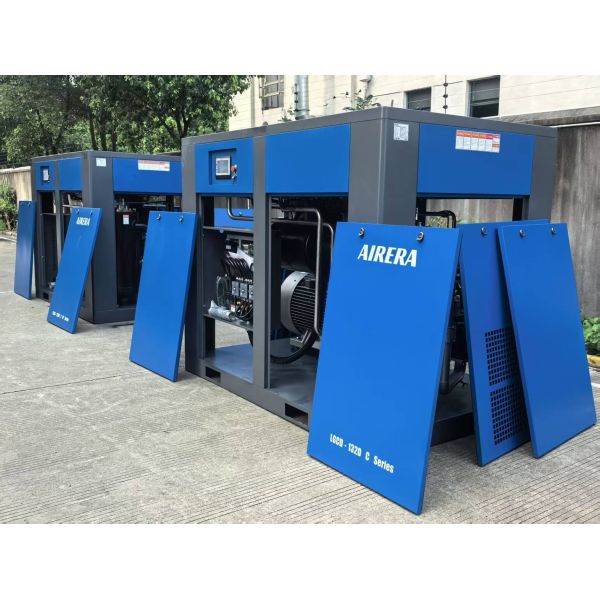
Engineered for the after-treatment of medium-to-large screw air compressors, this AIRERA 6.5Nm³/min energy-efficient heatless desiccant air dryer delivers premium deep dehumidification. The core system features premium, long-life molecular sieve desiccants, possessing exceptional moisture capacity and outstanding resistance to fluidization or crushing. As a flagship model in AIRERA’s green, energy-saving purification lineup, this unit utilizes an innovative airflow circulation architecture and smart timing sequences to minimize traditional purge air loss. While maintaining a consistently low dew point output to completely eliminate pipeline condensation, it significantly cuts comprehensive operational energy costs for modern factories, providing durable, pure, high-quality compressed air to safeguard sensitive pneumatic equipment and automated production lines.
Energy-Saving Purge Design
With purge air controlled within only 12-15%, it cuts compressed air waste drastically, bringing remarkable long-term operational savings for Middle East factories.

Steady Dew Point Performance
Maintains a stable pressure dew point between -20°C to -40°C even under 45°C hot inlet air, fully protecting downstream pneumatic components from moisture damage.

Wide Working Pressure Adaptability
Adapts seamlessly to 0.6-1.0Mpa working pressure, matching local power supply and pipeline conditions perfectly for hassle-free installation and operation.

| ITEM | UNIT | MODEL HDR-10XF |
|---|---|---|
| Capacity | Nm³/min | 6.5 |
| Motor | Power(kw) | 1.5 |
| Voltage | V | 380 |
| connection |
ZG1.5 |
|
| Dimension | L×W×H in mm | 1200×500×1950 |
| Weight | kg | 400 |
| Purge air | <=12~15% | |
| Working pressure | Mpa | 0.6~1.0 |
| Inlet oil content | ppm | <=0.01 |
| Pressure dew point | ℃ | -20℃~-40℃ |
| Desiccant | Activated aluminum or Molecular siere | |
| Working periods | T=4~20Minutes | |
| Inlet temperature | 0℃~45℃ |

As dedicated after-treatment equipment for screw air compressors, what advantages does this AIRERA 6.5Nm³/min dryer offer when handling the high discharge temperature and high moisture content typical of screw compressors?
Screw air compressors feature continuous large discharge volumes and thermal rise, which poses a severe challenge to the after-treatment condensation load. This AIRERA unit expands the effective adsorption volume of its dual towers and optimizes internal diffusion channels. Working alongside a high-efficiency upstream aftercooler and water separator, it pre-discharges most liquid condensate. The premium long-life molecular sieves inside maintain an extremely high adsorption rate even when facing 100% relative humidity inlet air, ensuring that the outlet air metrics remain unaffected by the high-load operation of the screw compressor.
The title highlights "Long-Life Molecular Sieves." How does it actually extend replacement cycles and maintain low degradation during actual operation?
Standard desiccants are prone to mutual friction and powdering under frequent pressure swing shocks, leading to flow channel blockages and performance degradation. The high-end molecular sieves adopted by AIRERA possess superior mechanical crush strength and chemical stability. Paired with proprietary "gravity dynamic compaction" and "airflow buffering" designs within the towers, the molecular sieves are tightly packed with zero room for shifting. This minimizes friction and fluidization while extending the service life by over 50% compared to traditional materials, drastically reducing media replacement costs for users.
Traditional heatless dryers utilize fixed-time switching, consuming a constant amount of purge air (typically up to 13-15%) regardless of actual production line demand. This AIRERA energy-efficient model introduces smart control logic based on "inverter linkage / dew point control (optional)." The system recognizes the actual load, discharge temperature, and humidity of the upstream screw air compressor in real time. When the production line operates under partial load, the control system automatically extends the adsorption cycle, reducing dual-tower switching frequency and depressurization exhaust cycles. This significantly lowers overall purge air consumption, translating directly into power savings for the factory.