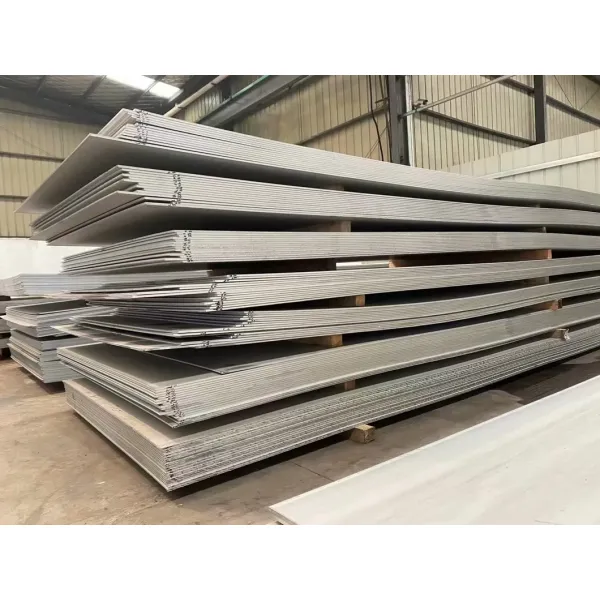
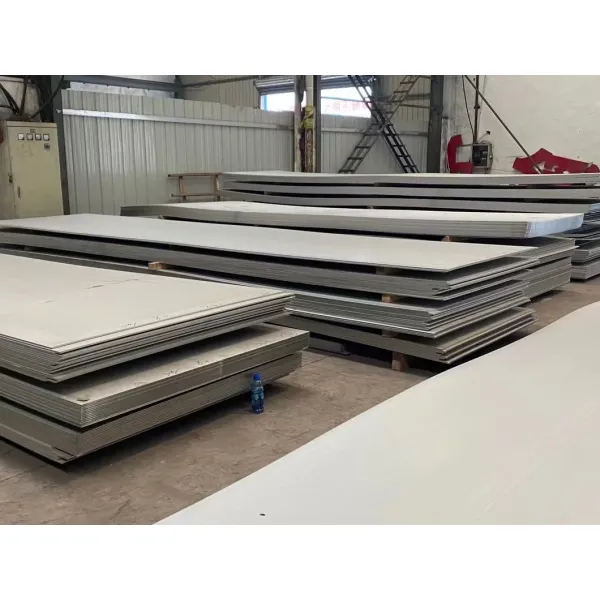
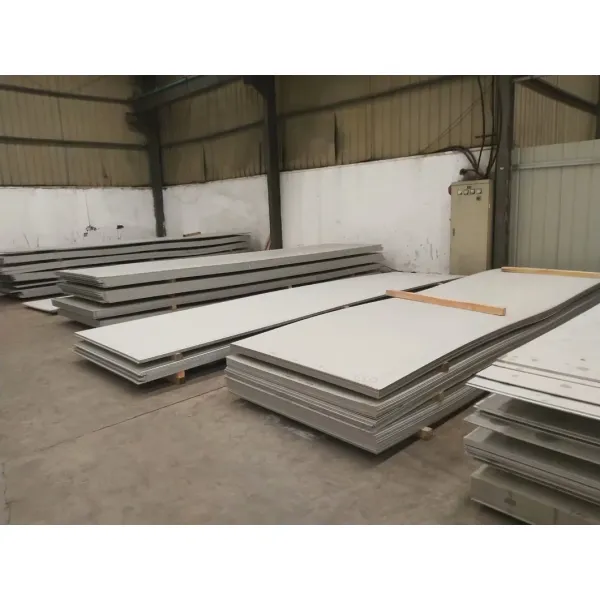
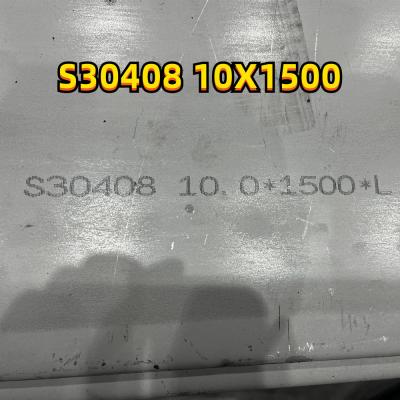
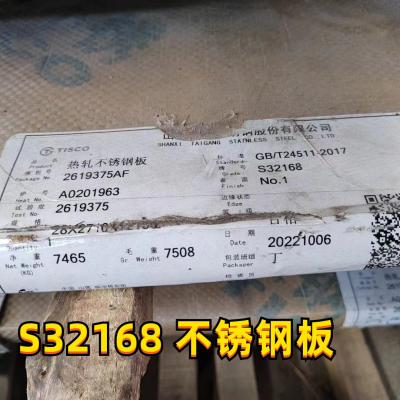
1.4362 Duplex Steel Plate ASTM A240 S32304 Stainless Steel Plate
Alloy 2304 (UNS S32304) is a 23% chromium, 4% nickel, molybdenum-free duplex stainless steel. This alloy offers corrosion resistance properties comparable to 316L stainless steel, while providing mechanical properties with yield strength approximately twice that of 304L/316L austenitic grades. This enhanced strength enables significant weight savings in properly designed pressure vessel applications.
Chemical Composition
Typical Values (Weight %)
| Carbon |
Chromium |
Nickel |
Molybdenum |
Nitrogen |
Others |
| 0.020 |
23 |
4 |
0.2 |
0.1 |
S=0.001 |
PREN = [Cr%] + 3.3 [Mo%] + 16 [N%] ≥ 24
Mechanical Properties
Tensile Properties (Minimum Values)
| °C |
Rp 0.2 MPa |
Rp 1.0 MPa |
UTS MPa |
°F |
YS 0.2% Offset KSI |
YS 0.1% Offset KSI |
UTS KSI |
Elongation % |
| 20 |
400 |
440 |
600 |
68 |
58 |
64 |
87 |
25 |
| 100 |
330 |
365 |
570 |
212 |
48 |
53 |
83 |
25 |
| 200 |
280 |
310 |
530 |
392 |
41 |
45 |
77 |
20 |
| 300 |
230 |
260 |
490 |
572 |
33 |
38 |
71 |
20 |
Values obtained for hot rolled plates (th ≤ 2"). Alloy 2304 must not be used for extended periods at temperatures exceeding 300°C (572°F) due to precipitation hardening phenomena.
Toughness Values (KCV Minimum Values)
| Temperature |
-50°C / -60°F |
+20°C / +70°F |
| Single |
75 J/cm² / 54 ft. lbs |
90 J/cm² / 65 ft. lbs |
| Average (5) |
90 J/cm² / 65 ft. lbs |
150 J/cm² / 87 ft. lbs |
Hardness (Typical Values)
| HV10 |
HB |
HRC |
| 180-230 |
180-230 |
≤ 20 |
Physical Properties
Density: 7,800 kg/m³ (0.28 lb/in³)
| Temperature Interval °C |
Thermal Expansion α×10⁻⁶ K⁻¹ |
Resistivity (μΩ·cm) |
Thermal Conductivity (W·m⁻¹·K⁻¹) |
Specific Heat (J·kg⁻¹·K⁻¹) |
Young Modulus E (GPa) |
Shear Modulus G (GPa) |
| 20-100 |
13 |
80 |
17 |
450 |
200 |
75 |
| 20-100 |
13 |
92 |
18 |
500 |
190 |
73 |
| 20-200 |
13.5 |
100 |
19 |
530 |
180 |
70 |
| 20-300 |
14 |
105 |
20 |
560 |
170 |
67 |
Microstructure
The chemical composition of Alloy 2304 is optimized to achieve a typical 50% austenite / 50% ferrite microstructure following solution annealing treatment at 950°-1050°C (1742°-1922°F). The microstructure of 2304 duplex stainless steel demonstrates superior stability compared to molybdenum-containing duplex grades. Intermetallic phases only appear after extended holding times of 10 hours within the 750°-850°C (1382°-1562°F) temperature range. When specified, copper additions to the 2304 grade enhance hardness following heat treatment in the 350°-500°C (662°-932°F) temperature range.
Processing Guidelines
Hot Forming
Hot forming should be performed within the 1150°-900°C (2100°-1650°F) temperature range. Following forming operations, a subsequent solution annealing treatment at 950°-1050°C (1742°-1922°F) is recommended to fully restore both corrosion resistance and mechanical properties. Components formed from 2304 alloy require careful support during heating processes to prevent creep deformation.
Cold Forming
Alloy 2304 can be cold formed without complications using the same equipment employed for 304L and 316L grades. Due to its enhanced mechanical properties and higher yield strength, increased forming stresses are necessary. A final solution annealing heat treatment is recommended after cold forming to restore optimal mechanical and corrosion resistance properties, as detailed in the hot forming section.
Descaling
Utilize the same solutions and pastes as those used for Alloys 304L/316L. Pickling times will be extended compared to austenitic grades due to the superior corrosion resistance characteristics of this alloy.
Machinability
Alloy 2304 duplex stainless steel exhibits improved machinability, particularly in drilling applications. Its performance is equivalent to 316LEZ*, while offering enhanced corrosion resistance and cleanliness properties since sulfur additions are unnecessary. This results in improved localized corrosion resistance behavior.